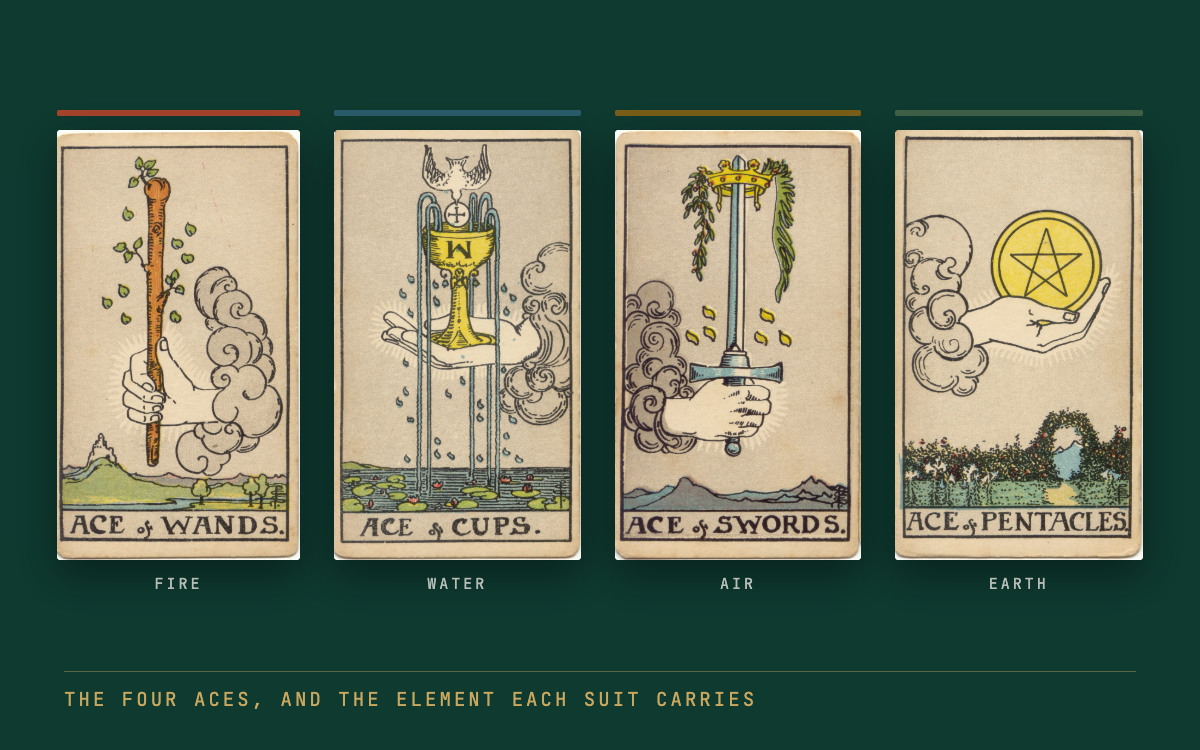
Open the reference sections on this site and the same field keeps appearing near the top of every entry. The Ace of Wands is Fire. Aries is Fire. Life Path 1 is Fire. A dream of falling is Air. It is a very short list of words doing the same job in four different places.
That is either a real structural fact about this material or a piece of tidying imposed on it after the fact. The answer turns out to be both, in proportions worth setting out, and the most useful part of the exercise is the one system that will not accept the scheme at all.
The same four words in four places
In the tarot the mapping is clean and total. Wands are Fire, Cups are Water, Swords are Air, Pentacles are Earth, and every one of the fifty-six minor cards inherits its element from its suit. Nothing is left over and nothing is ambiguous. The four aces are read as the root of each element, which is why they behave less like cards than like headings.
In astrology the same four words sort the twelve signs into triplicities, three signs apiece. Aries, Leo and Sagittarius are Fire. Taurus, Virgo and Capricorn are Earth. Gemini, Libra and Aquarius are Air. Cancer, Scorpio and Pisces are Water. Twelve divides by four without remainder, which is convenient enough that it is worth asking whether the convenience came first.
The numerology and dream sections carry the field too, and here the assignment is looser. Life Path 1 is Fire and Life Path 4 is Earth on grounds that are thematic rather than structural: initiative reads as fire, and the number associated with building and consolidation reads as earth. Nothing in the arithmetic of a Life Path produces an element. Somebody decided, sensibly, and the decision could have gone another way.
There is a test for whether a correspondence is doing work. Ask what it would take to be wrong. The tarot mapping is falsifiable in a weak sense: if the Golden Dawn had assigned the suits differently, the whole downstream literature would read differently, and it very nearly did. The astrological one is harder to shift, because it is load-bearing for aspect patterns and chart geometry rather than decorative. The numerological one is the weakest of the three, because nothing else in numerology depends on it. Remove the element field from the Life Path pages and no other claim on those pages changes. That is worth knowing when you decide how much weight to put on it.
Where the scheme came from
The four elements are Greek and they are specific. Empedocles, writing in the fifth century before the common era, proposed four roots of all things: fire, air, water and earth, mixed and separated by attraction and repulsion. Aristotle took them up and gave them a structure, pairing two qualities to each, hot and dry for fire, cold and wet for water, and so on, which is what turned a list into a system that could generate predictions.
It is worth noting that Aristotle needed a fifth. The four elements were sublunary, belonging to the changeable world below the moon; the heavens were made of aether, which did not partake of the four at all. The scheme was never meant to cover everything, and the version that reaches modern occultism has quietly dropped the boundary its author put around it.
The astrological triplicities are Hellenistic and are set out in Ptolemy's second-century Tetrabiblos, which means the element-to-sign mapping has been stable for roughly eighteen hundred years. That is a genuinely long run, and it is the strongest historical claim anything on this page can make.
The join that is not as old as it looks
The tarot half is much younger, and this is the part most sites leave out. For the first three centuries of its existence the tarot was a card game with four suits, batons, cups, swords and coins, and those suits carried no elemental meaning whatever. They were suits, in the sense that hearts and spades are suits.
The elemental attribution arrives with the Hermetic Order of the Golden Dawn in the 1880s and 1890s, which systematically welded tarot, astrology, Kabbalah and ceremonial magic into a single correspondence table. Waite and Smith's 1909 deck comes directly out of that milieu. When a modern book tells you that Swords are Air, it is repeating a decision that is about a hundred and forty years old, not one inherited from the Renaissance.
And the decision is not unanimous. The Golden Dawn assigned Wands to Fire and Swords to Air; a substantial continental tradition reverses the pair, putting Swords with Fire on the reasoning that a blade is forged and a wand is a living branch. Both readings have been in print for over a century. This site follows the Golden Dawn arrangement because it is the one the 1909 illustrations were drawn to, but there is no fact of the matter underneath the choice.
The system that refuses it
Now the useful part. The I Ching section of this site carries no element field at all, and that absence is deliberate rather than an oversight.
Chinese cosmology does have a scheme of this kind. It has wu xing, usually translated as the five phases: wood, fire, earth, metal and water. The overlap with the Greek list is partial and misleading. Two names coincide, air is missing entirely, wood and metal have no Greek counterpart, and, more fundamentally, the wu xing are not substances that things are made of. They are phases in a cycle, defined by how they generate and overcome one another: wood feeds fire, fire makes earth, earth bears metal, metal carries water, water grows wood. The relationships are the content. A static assignment of one phase to one object misses the entire point.
The I Ching does not use the five phases as its primary structure either. It uses eight trigrams, and their images are natural rather than elemental: heaven, earth, thunder, water, mountain, wind, fire, lake. Qian, three solid lines, is heaven, not fire, not air, not any of the four. Eight does not divide into four, the images do not pair off, and every attempt to force the correspondence has to discard something.
So the field is absent because the honest answer to which element Hexagram 1 belongs to is that the question does not apply. That is a more useful thing for a reference site to say than a plausible-looking answer would be.
Made visible
The classification is not only stored on this site, it is shown. Each element has a colour: fire a rust red, water a deep blue-green, air an ochre, earth a green. Every entry on the four elemental pillars takes its colour from its own element field and renders it twice, as a short rule beneath the title and as a small square beside the Element row. The Ace of Wands shows the fire colour in both places; the Ace of Cups shows the water one. In the catalogues the same colour runs as a three-pixel edge along the top of every tile, so the grouping is legible while you are still browsing rather than only once you have arrived at a page.
Two things this is not. It is not a second channel of meaning. The colour says nothing the Element row does not already say in a word, and a reader with images off, or who does not distinguish those particular hues, has lost no information whatever. Nor is it decoration chosen per page, which is the usual arrangement on sites like this one. It is a single stored field, rendered.
The I Ching pages carry no tint, no rule and no swatch, because those records have no element to render and no Element row to put one beside. The refusal that kept the field off those entries shows up in the design as an absence too, which is the right outcome rather than an oversight.
What a correspondence is for
None of this means the scheme is worthless. A classification does not have to be true to be useful; it has to be consistent, and it has to be applied to material it fits. Four elements across the tarot suits and the zodiacal triplicities is consistent, historically continuous in the astrological case, and genuinely helpful for reading. Knowing that Cups and water imagery and the Water signs share a register tells you something real about how those readings behave.
What it is not is a discovery. Nobody found the four elements running through these systems; the correspondence was built, most of it inside a single generation of English occultists in the late nineteenth century, and it was built well enough that it now looks like something found. The distinction matters mainly when the scheme stops working, because a discovered pattern that breaks is evidence and a constructed one that breaks is just a construction reaching its edge.
The edge, on this site, is the I Ching. Four of the five sections take an element. The fifth does not, and if the classification were a fact about the world rather than a convention applied to it, that would be a problem. It is not a problem. It is the shape of the thing being visible.