- Card number
- 21
- Arcana
- Major Arcana
- Suit
- Major Arcana
- Element
- Earth
- Rank
- Trump
- Roman numeral
- XXI
- Planetary attribution
- Saturn
- Yes or no reading
- Yes
The World
The last card of the Major Arcana, and a card of completion that includes the ending. The World describes something finished properly, which is rarer and less comfortable than it sounds.
- completion
- wholeness
- closure
- arrival
- integration
- incompletion
- delay
- clinging
- loose ends
- stagnation
What the card shows
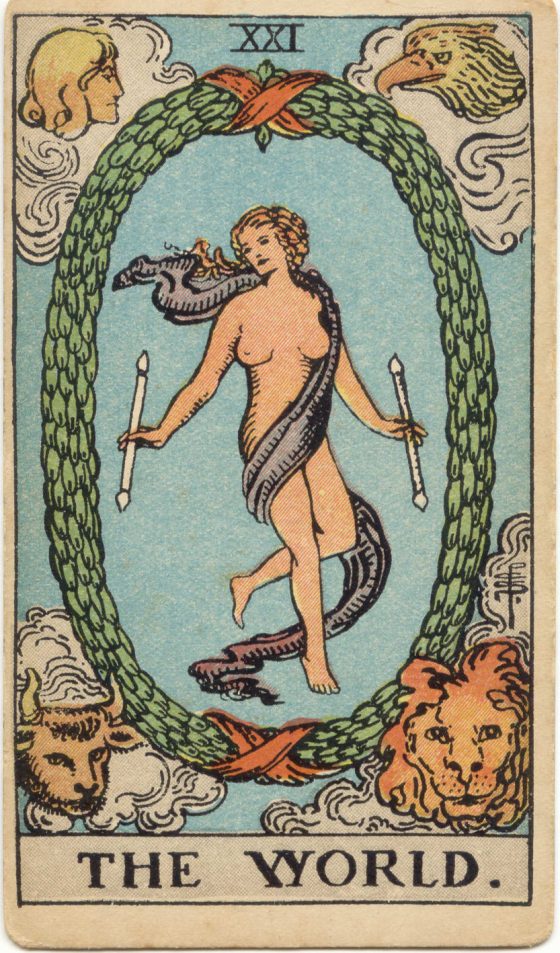
A naked figure floats at the centre of a large green laurel wreath, legs crossed at the knee, a violet-grey cloth draped over one shoulder and across the hips. A short white wand is held in each hand, pointing in opposite directions. The wreath is bound at top and bottom with red ribbon. The figure's head is turned to one side and slightly down.
In each corner of the card, set against pale cloud, is a head: a fair-haired human face at the top left, an eagle at the top right, a horned bull at the bottom left, and a lion at the bottom right. The space inside the wreath is plain pale blue. No ground is drawn anywhere in the picture.
Upright meaning
The World is the last numbered trump and it describes completion in the strict sense: a thing has finished, and finishing it involved an ending. Most cards about achievement are about arriving somewhere. This one is about a cycle closing, which necessarily means something is now over.
Drawn upright it usually marks the end of a long process that was actually seen through: a qualification finished, a project delivered, a period of life concluded rather than abandoned. The distinguishing quality is completeness. Nothing is outstanding, nothing needs to be gone back to, and that condition is much less common than people assume. Most things do not end; they simply stop being worked on.
It is also a card with no ground in it. The figure is suspended, the wreath encloses nothing but sky, and there is no indication of what happens next. Beside Judgement, which precedes it, The World reads as the settled state after a reckoning; beside The Fool, whose number is zero and who stands at the other end of the same sequence, it reads as an ending that is about to become a beginning.
Upright in love
In relationship readings The World describes something that has reached its full shape. A relationship that has become what it was going to become, for better or worse. It is a card of arrival rather than of momentum, and arrival is not always the same as continuing.
It reads well for commitments being formalised and for long partnerships that have settled into something durable. It reads equally well, and this is less often said, for relationships that have completed and can now be put down without anything left unfinished. The card indicates wholeness, not duration. Where the question is whether something will last, The World says it is entire, which is a statement about its present shape and not about its future.
Upright in work
At work The World is the finished thing: the project signed off, the qualification awarded, the role completed rather than left. It usually appears at the end of something substantial, and it carries a quality of consolidation that shorter cards do not.
It reads well for anything being closed out properly, and for work that has taken years to reach its current standing. It is a weaker card for questions about the next step, because it describes a state rather than a direction. Compare Ten of Pentacles, which is the same completeness expressed as an institution rather than as an achievement. The World is more portable and less secure.
Upright in money
In money questions The World usually describes a position that is settled: a debt cleared, a long arrangement concluded, a set of accounts that finally balance. It marks the closing of something rather than the size of what remains.
It gives no indication of amount. A completed position can be a modest one, and the card is equally accurate for someone who has finished paying off a small loan and someone who has finished building something substantial. What it says is that the matter is complete and nothing further is outstanding on it, which is worth confirming against the paperwork rather than assuming.
Upright as feelings
Completed feeling. As someone's feelings, The World usually means the person has arrived at a settled position about you, and that nothing about it is still forming. That is not automatically warm. A settled position can be affection that has become permanent, or it can be a matter that has been closed. The card indicates finality rather than direction.
Upright as advice
Finish it and mark the finish. Whatever has been substantially done for weeks but never formally closed, close it: send the final version, file the last document, tell the people who need to know it is complete. The World's advice is about making an ending explicit rather than letting it trail off.
Reversed meaning
Reversed, The World gives two readings, and the difference between them is whether the ending is late or unwanted.
The first is incompletion. Something is nearly done and has been nearly done for a long time. The last ten per cent, the final conversation, the paperwork that would make it official. Nothing is wrong with the work; it simply has not been closed, and the not-closing has started to cost something.
The second is refusal to let go of something already finished. Reversed, the card often describes a person maintaining a situation whose substance ended some time ago: a role they have outgrown, a relationship being kept in a form neither person believes in, a project that stopped mattering and is still being worked on. Here the incompleteness is deliberate, because completing it would mean admitting it is over.
Which one is in play is decided by the spread and by an uncomfortable question: whether the querent wants this finished. Cards of effort nearby support the first. Cards of attachment or stagnation support the second.
Reversed in love
Either a relationship that is almost at a point of definition and keeps not arriving there, or one that ended in substance a while ago and is being maintained out of habit or dread. The second is more common than the first. Reversed, the card is a reasonable prompt to ask when the last genuinely new thing happened between two people, and to notice if the honest answer is a long way back.
Reversed in work
A project stuck at ninety per cent, or a role that finished being interesting some time ago and is still being performed. Both produce the same outward appearance of continuing employment. Reversed, this card is worth reading as a question about closure: what would have to happen for this to be finished, and is anyone actually working toward that, or is the current state now the arrangement?
Reversed in money
An arrangement that has not been formally closed, or one that was closed and is still being treated as open. The first leaves a small liability running longer than it needs to. The second is usually a person still budgeting around a commitment that ended. Reversed, the card recommends checking what is actually still live rather than what feels still live, because those two lists differ more often than people expect.
Reversed as feelings
Feeling that has not quite resolved, or feeling that resolved a while ago and is still being described in the old terms. Reversed, the card frequently marks someone who would say the relationship is fine and could not say what it currently is. The vagueness is the information.
Reversed as advice
Write down what completion would actually look like, in specific terms, and then find out whether anyone is working toward it. If the answer is no, the thing is not unfinished; it is over, and continuing to treat it as unfinished is the cost you are currently paying.
Symbolism in the 1909 image
The wreath. Green laurel, oval, bound top and bottom with red ribbon. Laurel is a victory wreath in classical use. It is also a closed shape, and the figure inside it is enclosed as much as crowned, which the standard reading tends not to dwell on.
The four heads. A man, an eagle, a bull and a lion, one in each corner. They are the four living creatures of Ezekiel and Revelation, and the same four appear on the Wheel of Fortune in this deck. Their presence signals fixity and completion rather than anything about the figure.
The two wands. One in each hand, short, white, identical. The Magician holds a single wand raised; here there are two, held level and pointing opposite ways. Read as balance. The drawing supports it, though nothing indicates what the wands are for.
The drapery. A violet-grey cloth wound over one shoulder and across the hips, covering very little. It is the only clothing in the card and it is doing no practical work. Whether the figure is dressed or undressed is left genuinely unclear.
The absent ground. There is no floor, no horizon and no landscape anywhere in the image. Almost every other trump places its figure in a landscape. This one does not, and for a card about completion the absence of any ground to stand on is the most interesting thing in it.
Where this meaning came from
The final trump was not always called The World and did not always show a dancer. Fifteenth-century Italian versions vary considerably: some show a city floating above a landscape, some a figure holding a globe, some two putti supporting an orb. The idea being illustrated was the created world, quite literally, not a state of personal completion.
The four corner creatures are much older than tarot. They come from Ezekiel and from Revelation, were used throughout medieval art as the symbols of the four evangelists, and appear in the same arrangement on countless church carvings. Their presence on the card is inherited Christian furniture rather than an occult code, though a great deal has been written treating it as the latter.
Court de Gebelin's Egyptian theory of 1781 and Etteilla's system that followed supplied the divinatory meanings, on foundations that were invented. Waite and Smith produced the 1909 image, and The Pictorial Key to the Tarot in 1910 described the card in terms of the completed Great Work, borrowing from the Golden Dawn material Waite had sworn not to publish and published in part anyway. Smith's dancing figure is the version everyone now pictures. She was paid a flat fee for it.
The common misreading
The World is read as unqualified good news more often than any card except The Sun, and the reading usually skips what completion costs. Something ending well is still something ending. Querents who draw this card about a situation they want to continue are frequently being told, in the deck's own terms, that it has reached its final shape.
The second misreading is treating it as a guarantee of success. The card describes a cycle closing, not a cycle closing favourably. A long project can be completed and be a failure; a relationship can reach its full form and that form can be an ending. The World says the thing is whole. It does not say the thing is good.
The third is the travel reading. Because of the title, this card is routinely reported as meaning foreign travel or relocation. That association comes from the name rather than from anything in the picture, which contains no map, no ship, no road and no ground at all. Compare Eight of Wands, which actually depicts movement, and note how much less often it gets read as a holiday.
Questions to sit with
- What in your life is substantially finished but has never been formally ended?
- If this reached its natural completion tomorrow, what would you have to admit was over?
- What did this cost you, and would you say so out loud to someone who asked?
- Are you working toward finishing this, or toward keeping it going?
Pull this card in a real spread.