- Card number
- 20
- Arcana
- Major Arcana
- Suit
- Major Arcana
- Element
- Fire
- Rank
- Trump
- Roman numeral
- XX
- Yes or no reading
- It depends
Judgement
A card about being called to account, publicly and by something outside yourself. Judgement describes a reckoning that has already been set in motion, and it does not say what the verdict is.
- reckoning
- awakening
- assessment
- summons
- accounting
- avoidance
- self-blame
- delay
- refusal
- rumination
What the card shows
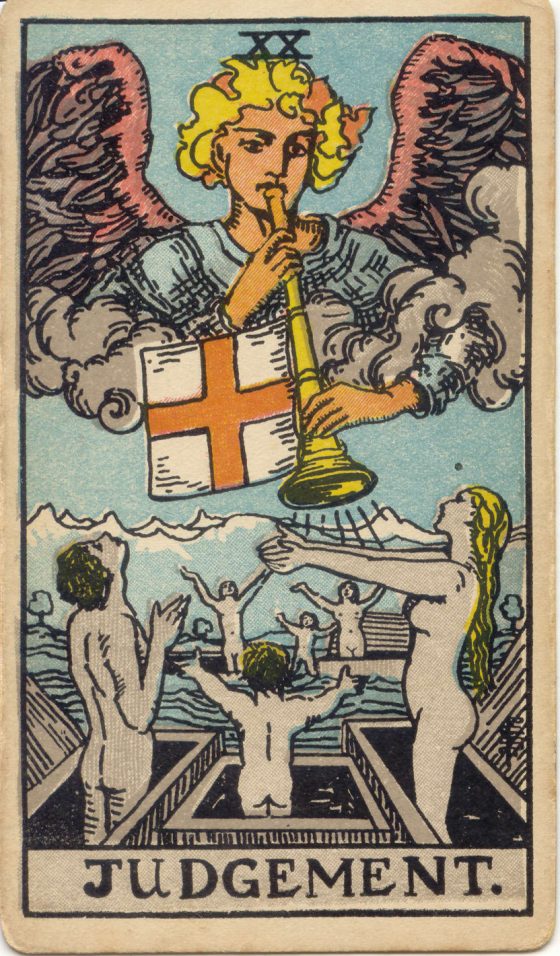
An angel with large red wings leans out of a bank of grey cloud across the top of the card, blowing a long straight trumpet. A square white banner with a red cross on it hangs from the trumpet. The angel's hair is yellow and the face is turned down toward the ground.
Below, three grey figures stand in open coffins floating on water, arms raised toward the trumpet. A man on the left and a woman on the right are seen from behind, and a child stands between them, also facing away. Further off, more figures rise from more coffins in the same posture. Trees stand at the left and right edges of the lower scene, and snow-covered mountains close the horizon.
Upright meaning
Judgement is the card of the moment when something that has been building becomes official. A decision announced, a diagnosis given, a conversation that cannot be walked back. The distinguishing feature is that the querent did not choose the timing. Something external calls, and the response is to stand up.
Drawn upright it usually describes a genuine turning point rather than an incremental change: an assessment being made, a body of past work being weighed, a person seeing their own history laid out and recognising it. Waite read it as awakening. That is fair, provided awakening is understood as involuntary. Nobody in the picture summoned the trumpet. The card is about being seen accurately, which is not the same as being seen kindly.
What the card does not supply is the verdict. The figures are drawn rising, not judged; the outcome is outside the frame. This is the most frequently ignored fact about the card. Beside Death it reads as a change already complete and now being acknowledged; beside cards of avoidance it reads as a reckoning arriving whether or not the querent is ready to meet it.
Upright in love
In relationship readings Judgement usually marks the point where an unspoken situation becomes explicit. A conversation that has been postponed for months happens. A pattern that both people could see gets named. The card often turns up around reconciliations, but it is not a card of reunion so much as a card of accounting.
It tends to appear when history is the actual subject. What was done, what was not said, who has been carrying what. The card supports facing that directly and offers no view on whether the relationship survives it. Where a querent hopes this card means someone is coming back, the honest reading is that it means someone is going to have to answer for something, which is a different event.
Upright in work
At work Judgement is the review, the audit, the decision that has been pending. It describes assessment by someone with the standing to make it, and it usually arrives on a schedule the querent did not set.
It reads well for anything where past work is being weighed as a whole: promotion cases, funding decisions, professional accreditation, the moment a long project is finally evaluated. It reads poorly as a card of daily activity, because it describes an event rather than a process. If the question was what to do next, Judgement's answer is that something is about to be decided and the useful work is making sure your account of it is accurate and ready.
Upright in money
In money questions Judgement is the reckoning: the statement opened, the return filed, the total of several years of decisions arriving in one document. It frequently marks the point where a situation stops being vague.
The card carries no indication of whether the number is good. It says the number is about to be known and that it reflects things already done. Nothing here can be influenced by the reading. Where money is owed or owing, this card describes the arrival of the formal position rather than any judgement about it.
Upright as feelings
A feeling that has resolved into a conclusion. As someone's feelings, Judgement usually means the person has worked something out about you and about themselves, and that the working-out is finished. It is not a warm card and not a cold one. What it indicates is that a position has been reached and is about to be stated.
Upright as advice
Answer the thing you have been leaving unanswered. The letter, the message, the request for a decision that has been open for weeks. Judgement's advice is not to prepare further; it is to respond, on the record, in a form the other party can act on.
Reversed meaning
Reversed, Judgement splits into two readings that are easy to confuse and point in opposite directions.
The first is the call refused. Something has been decided, communicated, or made plain, and the querent is declining to act on it. The letter unopened, the result not looked up, the conversation deferred once more. This is the standard book reading and it is often right.
The second is self-judgement standing in for the real thing. Reversed, the card frequently describes someone conducting a continuous private trial of themselves, going over old decisions, assigning blame, reaching verdicts nobody asked for. It looks like accountability. It functions as a way of never having to hear anyone else's assessment, because the querent has already delivered a harsher one.
The spread decides which. Cards of avoidance nearby support the first; cards of rumination and isolation support the second. The two need different responses, and treating the second as the first, by telling a person already flaying themselves that they need to face facts, makes it worse.
Reversed in love
Either a conversation that needs to happen is being avoided, or it has happened so many times in the querent's head that the actual version now feels redundant. Reversed, this card often marks a person waiting to be forgiven by someone who has not been asked, or refusing forgiveness that was already offered. Compare The Hanged Man nearby, which describes suspension that is deliberate rather than stuck.
Reversed in work
A decision delayed, or a decision made and not accepted. The first is administrative and passes. The second is a person continuing to argue an assessment that has already been filed, which costs standing without changing the outcome. Reversed, the card is also common where someone is avoiding a review they expect to go badly. Expecting it to go badly is not the same as knowing, and the card does not confirm the fear.
Reversed in money
Paperwork not opened, or a position known and not acted on. Reversed, Judgement in money is rarely about the size of a problem and almost always about the delay between finding out and responding. That delay has a cost, and it is usually a larger one than the original position. The card does not say the news is bad. It says the envelope is still sealed.
Reversed as feelings
Someone who has reached a conclusion and is not saying it, or someone stuck in reviewing rather than concluding. Reversed, this position often describes a person who feels judged rather than one who is judging. That distinction is worth holding, because the querent frequently reads the first as the second.
Reversed as advice
Open the thing you have not opened. The envelope, the results, the message you have been leaving marked as unread. Do it today and do it before you have decided how to feel about it. Reversed, this card describes a cost that is entirely produced by the delay, not by the contents.
Symbolism in the 1909 image
The trumpet. Straight, long, and pointed down at the figures. It is the only object in the card doing anything. Read as a summons, and note that a summons is not a sentence: the instrument announces, it does not decide.
The banner. A white square with a red cross, hanging from the trumpet. The cross is equal-armed rather than a crucifix. Waite avoided naming it precisely, and the design is common enough in medieval and heraldic use that reading a specific doctrine into it is reaching.
The coffins. Open, grey, and floating on water rather than buried in ground. The detail is easy to miss and it changes the card: nothing here is being dug up. The dead were already on the surface, in the open, waiting.
The raised arms. All the figures make the same gesture. It reads as welcome, as surrender, and as the posture of someone being searched, and Smith drew it ambiguously enough that all three are available.
The mountains. Snow-covered, distant, closing the horizon behind the water. They appear on several cards in the deck in almost identical form. Their presence here is compositional as much as symbolic, which is worth remembering before assigning them meaning.
Where this meaning came from
This card began as a straightforwardly Christian one. In the fifteenth-century Italian decks it was the Last Judgement, an ordinary subject in devotional art of the period, and it needed no explanation to the people playing with it. The angel, the trumpet and the rising dead are all inherited directly from that iconography.
The occult reinterpretation came later, in eighteenth-century France, where Court de Gebelin and then Etteilla recast the trumps as Egyptian mysteries. This required the Christian content to be explained away rather than removed, and the card kept its Christian picture while acquiring a meaning about renewal and rebirth that sat awkwardly on top of it.
Waite, writing in 1910, was openly uncomfortable with the traditional title. In The Pictorial Key to the Tarot he argued the card was not about the Last Judgement at all but about a change of consciousness, and he kept Smith's thoroughly conventional Christian image anyway. Smith drew it for a flat fee and signed it with her initials. The tension between the picture and the gloss has never been resolved, and most modern books reproduce both without noticing they disagree. The card that follows it, The World, resolves what Judgement only announces.
The common misreading
Judgement is regularly read as a verdict, usually a favourable one. The card does not contain a verdict. It contains a summons and a set of figures standing up. Everything about the outcome is outside the frame, and a reader who says this card means you will be vindicated has supplied the ending themselves.
The second misreading is moral. Because of the title and the Christian imagery, the card gets used to tell people they are being called to account for something they did wrong. Nothing in the picture assigns fault. The figures are not cowering; they are rising with their arms up. Read it as an assessment rather than a punishment, and notice how often the punitive reading is one the querent brought and the reader agreed to.
The third is the reunion reading. In love questions Judgement is widely reported as meaning an ex will return. This has no basis in the card, and it persists because it is what people most want to hear when they draw it. What the card actually describes is something unresolved becoming explicit, which can as easily be a final conversation as a first one. Compare The Tower, which nobody tries to read as a reunion.
Questions to sit with
- What have you left unopened or unanswered, and how long has it been?
- Whose assessment of this are you actually waiting for?
- If you had to give a full account of the last two years of this, what would you leave out?
- Are you being judged, or are you doing the judging and calling it something else?
Pull this card in a real spread.