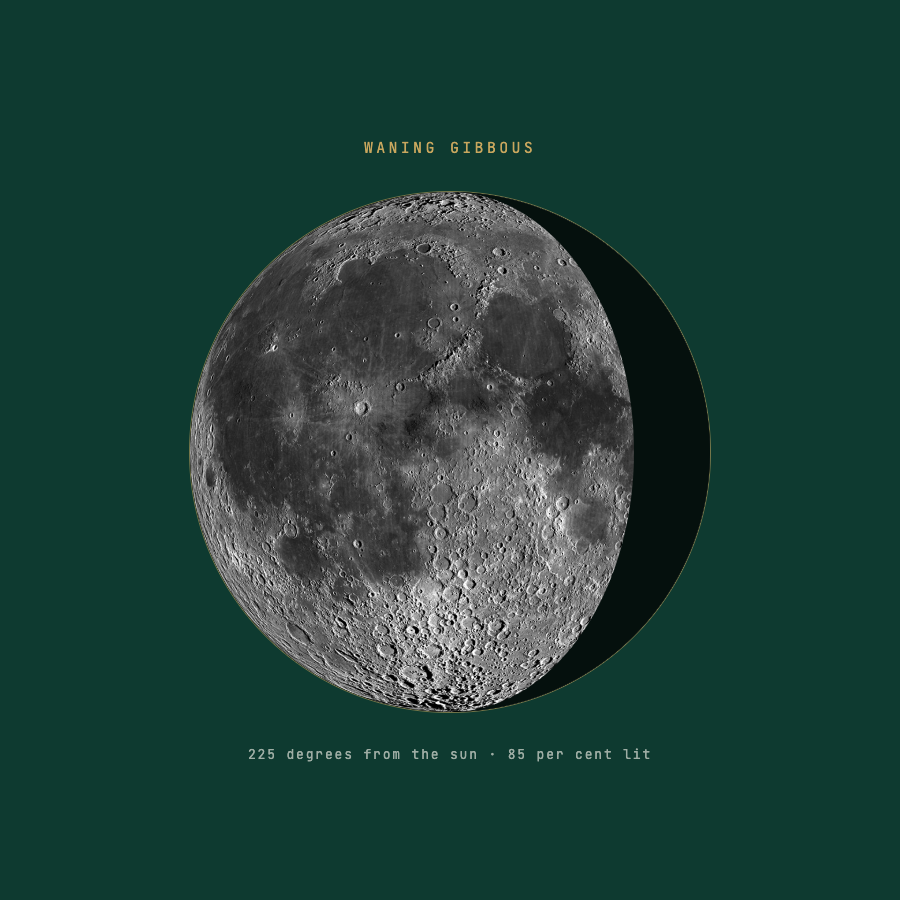
- Phase
- Waning gibbous
- Roughly how much is lit
- 99 to 51%
Waning gibbous
Past full and beginning to shrink, still more than half lit. A waning gibbous rises after dark and is still up after sunrise, which makes it the first properly morning phase of the cycle.
- past full
- morning
- releasing
- diminishing
- late rising
What you actually see in the sky
This is where the Moon starts keeping inconvenient hours. A waning gibbous rises well after sunset, somewhere in the late evening, is highest in the small hours, and is still above the horizon well into the morning. If you go to bed at a normal time you will miss the rise, and if you are up early you will find it high in the western sky in daylight.
That daytime visibility is the thing worth knowing. A waning gibbous is easy to spot on a bright morning, pale and obvious against blue, and it is the phase most people have seen without registering what they were looking at. The Moon in the morning sky is always past full; the Moon in the afternoon sky is always before it. That single rule lets you tell waxing from waning without knowing the date.
The lit side has switched. Where a waxing gibbous was flattened on the left in the northern hemisphere, this one is flattened on the right, because the Sun is now illuminating it from the other side. Southern hemisphere observers see the mirror image of all of this, and the moon tool draws the northern view. The terminator has returned to the visible face, so surface detail comes back through binoculars after the flat glare of full, and the craters along that line are lit from the opposite direction to the ones you saw before.
What the astronomy says
Phase is the angle between the Moon and the Sun as seen from Earth. A waning gibbous occupies the stretch where that angle has passed a hundred and eighty degrees and is closing again, roughly between a hundred and eighty-six and two hundred and sixty-four degrees, which works out at about ninety-nine down to fifty-five per cent lit.
Nothing about the shrinking involves Earth's shadow. That is a lunar eclipse, it happens only at the moment of full, and it is over in hours rather than days. The gradual loss of light here is the same geometry that produced the gradual gain before full, running in reverse: the lit hemisphere is turning away from us as the Moon moves on around its orbit.
The reason the Moon rises later each night, by roughly fifty minutes on average, is that it has moved about thirteen degrees further along its orbit while Earth turned once. That accumulating delay is what carries the Moon out of the evening sky and into the morning one over the course of a week. The cycle averages 29.53 days and varies by about half a day either side, because the orbit is an ellipse and the Moon speeds up when it is nearer.
What the tradition reads into it
The waning half of the cycle is read almost universally as the mirror of the waxing half: where that was for building and attracting, this is for clearing, reducing and letting go. The waning gibbous is the beginning of that, and in the systems that name all eight phases it is the point at which something completed starts to be shared, taught or distributed rather than added to.
The almanac tradition applied the same logic to the ground. The days after full were for harvesting, for pulling weeds, for cutting timber that needed to dry, and for sowing root crops, on the reasoning that a waning moon draws energy downward. The rules are consistent and have been printed continuously since the eighteenth century. No mechanism has been demonstrated and controlled trials have not found the effect.
It is worth noticing how neatly the tradition maps onto what is actually visible. The Moon is getting smaller, so the phase is assigned to things getting smaller. That is not evidence of ancient insight so much as evidence that people reason by analogy from what they can see, which is a fair description of how most of this material was built. The analogy is genuinely useful as a mnemonic and it is not a finding about the world.
How the sign it falls in changes the reading
Phase and sign are separate measurements of a single moment. The phase is the Moon's angle from the Sun; the sign is its longitude along the ecliptic, and it changes roughly every two and a half days whatever the phase is doing.
A waning gibbous runs between about two hundred and three and two hundred and forty-eight degrees from the Sun, which is between six and a half and eight signs onward. During Aries season that puts it around Scorpio or Sagittarius. Counting forward from the Sun is the same as counting back, so it can equally be described as four or five signs behind.
The phase band is forty-five degrees wide and the Moon covers about half a degree an hour, so a waning gibbous lasting three and a half days will nearly always span two signs. That is the normal case. It is also the clearest practical demonstration that the two facts are independent, since the phase name persists across a sign change and the sign persists across a phase change. Neither measurement can be worked out from the other.
What research has actually measured
The evidence on lunar effects is the same at every phase and belongs on every page rather than only the loud ones.
The Moon exerts no meaningful physical force on a human body. Tidal force falls off with the cube of distance and scales with the size of the object being stretched, which is why it raises tides in ocean basins thousands of kilometres wide and does essentially nothing across something under two metres tall. The popular argument from the tides to the water in a person fails on the arithmetic rather than on the idea.
Large studies looking for lunar effects on behaviour have come back negative. Rotton and Kelly's 1985 meta-analysis of thirty-seven studies found no reliable relationship between phase and psychiatric admissions, crime or crisis calls, and later work on birth rates and emergency attendance has been similar. The finding with better support is that a bright moon disrupts sleep, most plausibly through light. The timing matters here: a waning gibbous rises late, so it leaves the early part of the night dark and only brightens the small hours. If the mechanism is light in the hours when people are falling asleep, this phase should show less effect than the nights before full, which is a testable prediction rather than a symbolic claim.
Where this meaning came from
The waning gibbous has almost no folklore of its own, and the reason is the same as for its waxing counterpart: it is neither an extreme nor a boundary, so it was never a useful calendar marker. Traditions mark what can be identified confidently by eye, and a moon that is nearly but not quite full does not qualify.
Where it does appear in the historical record is in the practicalities of night travel. The nights immediately after full still offered usable light for several hours, but it arrived later each evening, and medieval and early modern accounts of journeys and markets are noticeably organised around that decay. The full moon got the festival; the days afterwards got the logistics.
The eight-phase framework that gives this stretch a distinct meaning is recent. Naming all eight and running a narrative of development through them is largely a twentieth-century astrological construction, set out most influentially by Dane Rudhyar in the 1960s. Older systems used the four principal phases and left the intervals unnamed, so anything presented as ancient waning gibbous lore is almost certainly modern, whatever older vocabulary it has borrowed to describe itself.
The common misreading
The commonest misreading is that the growing dark edge is Earth's shadow creeping across the Moon. It is not, and this is the most widespread misconception about the Moon in general. Earth's shadow touches the Moon only during a lunar eclipse, which occurs at the moment of full and lasts a few hours, not over a week. What you are watching is the lit hemisphere turning away as the Moon moves round its orbit.
The second is mistaking it for waxing. The two gibbous phases look nearly identical apart from which limb is flattened, and people routinely photograph a waning moon and caption it as building toward full. The reliable test is the clock rather than the shape: if the Moon is in the sky in the morning it is waning, and if it is there in the afternoon it is waxing. That works from either hemisphere, which the left-and-right rules do not.
The third is treating the waning half as a period when things should be wound down. The tradition reads it that way and the analogy is obvious, but there is no mechanism, and somebody who defers a decision because the Moon is shrinking has let a symbol make a scheduling choice. Compare full moon, where the same reasoning produces the opposite instruction, and last quarter, where it hardens further.
Questions to sit with
- What is finished enough to hand to somebody else?
- What are you still adding to that would be better simply released?
- Have you ever noticed the Moon on a morning commute, and did you know it was past full?
- What would you stop doing if you were sure nobody would mind?
See where the Moon is right now.