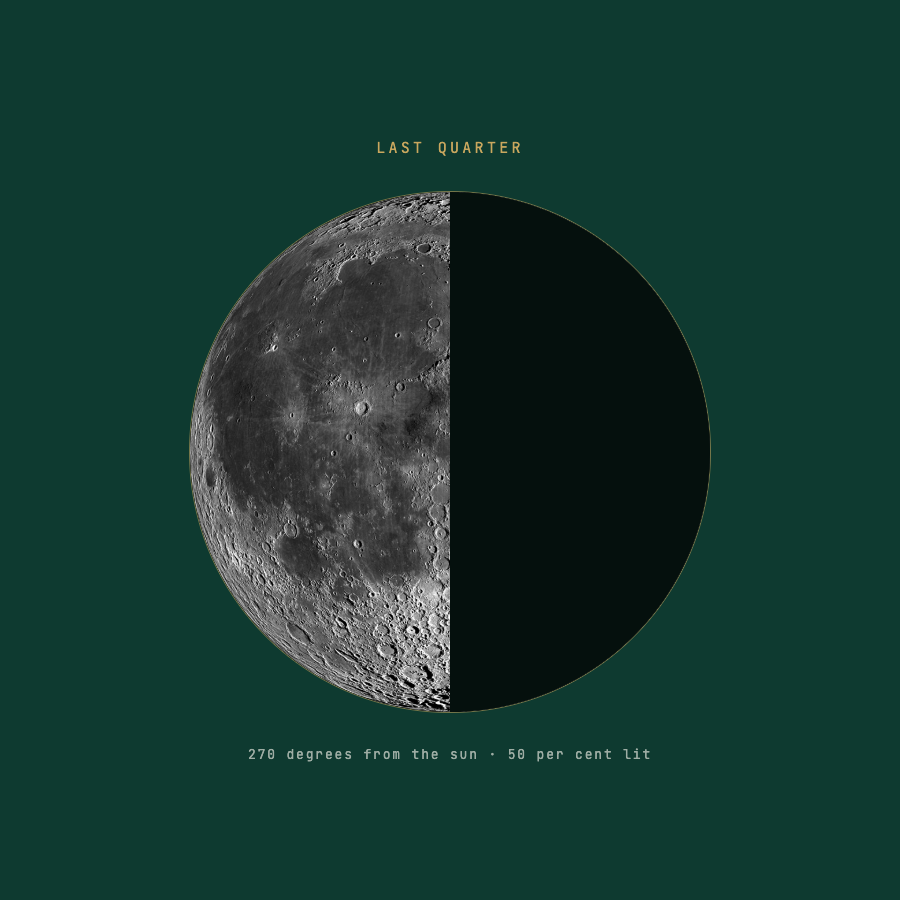
- Phase
- Last quarter
- Roughly how much is lit
- 50%
Last quarter
Half the disc lit and shrinking. A last quarter moon rises around midnight and sets around noon, so it belongs to the second half of the night and the first half of the day.
- half lit
- midnight
- releasing
- morning sky
- turning point
What you actually see in the sky
A last quarter moon rises around midnight, is highest at about sunrise, and sets around midday. That is the mirror of first quarter, and it is why this is the phase most people never knowingly see: it is not in the sky at any hour when a person with ordinary habits is outside and looking up in the dark.
The way to catch it is in daylight. On the mornings around last quarter the Moon is high in the southern sky, half lit and clearly visible against the blue, and it stays up until lunchtime. If you have ever noticed a pale half moon while walking somewhere before noon, that was this phase, and it cannot have been any other.
Northern hemisphere observers see the left half lit, which is the reverse of first quarter, because the Sun is now on the other side. From the southern hemisphere it is the right half, since the whole view is mirrored, and the moon tool draws the northern version. Through binoculars this is one of the two best phases for surface detail, along with first quarter: the terminator runs down the middle of the visible face, and craters along it throw long shadows that make the relief obvious. The features picked out now are the ones that were flat and washed out at first quarter, because the light is arriving from the other direction.
What the astronomy says
Phase is the angle between the Moon and the Sun as seen from Earth. At last quarter that angle is two hundred and seventy degrees, which is three quarters of the way round the cycle from new moon. The name counts position in the cycle, not the fraction of the disc that is lit, which is why a half-lit moon is called a quarter.
Exactly half the visible face is lit because the Moon is being illuminated from precisely the side. Illumination is one minus the cosine of the elongation over two, and at two hundred and seventy degrees that gives one half, the same value as at first quarter. The two quarters are geometrically identical and differ only in which side is lit and in what time of day the Moon is up.
As with every phase, none of this involves Earth's shadow, which reaches the Moon only in a lunar eclipse at the moment of full. And as at first quarter, the printed name covers a short window rather than the instant itself. This site applies the label within six degrees either side of two hundred and seventy, about eleven hours, which spans roughly forty-five to fifty-five per cent lit; outside that window it prints waning gibbous or waning crescent instead. So a last quarter reported here is always close to half, and the fifty per cent above is the value at the instant.
What the tradition reads into it
The last quarter is read as a turning point in the same way the first is, but pointed the other way. Where first quarter is the decision to continue, this is treated as the point of release: the moment something is acknowledged to be over, or a commitment is allowed to lapse rather than renewed.
Agricultural almanacs treated the fourth quarter of the month as the barren period, discouraged from planting altogether and reserved for clearing, weeding, cutting and destroying pests. It is the one stretch of the cycle where the almanac tradition advises doing very little of consequence. As with all of these rules, the practice was widespread, internally consistent and unsupported by any demonstrated mechanism.
In modern practice this is the phase of forgiveness, of letting go and of clearing space, and that framing arrives through the twentieth-century eight-phase model rather than from older sources. What the older material offers instead is the same shape in blunter form: the light is going, so this is when you tidy up. The elaboration into an emotional process is recent, and it is worth knowing which layer you are being handed when a page describes this phase as a time for forgiveness.
How the sign it falls in changes the reading
Phase and sign are two measurements of one moment. The phase is the Moon's angle from the Sun; the sign is its position around the ecliptic, and it changes roughly every two and a half days independently of the phase.
At last quarter the Moon is two hundred and seventy degrees ahead of the Sun, which is nine signs on, or equivalently three signs behind. So a last quarter moon falls three signs before the Sun's sign: during Aries season it sits around Capricorn, and during Cancer season it sits near Aries. Like first quarter, this is a ninety-degree relationship, which is why astrological language calls both quarters squares.
The band is forty-five degrees wide and the Moon moves about half a degree an hour, so in practice the sign may be the third or the fourth one back depending on exactly when you look. If the sign matters for your purposes, read it off the tool for the specific moment rather than working it out from the rule of thumb.
What research has actually measured
The evidence does not vary by phase, so the same summary belongs here as everywhere else in the cycle.
The Moon exerts no meaningful physical force on a human body. Tidal force falls off with the cube of distance and scales with the size of the object being stretched, which is why it moves ocean basins thousands of kilometres across and does effectively nothing across a person under two metres tall. The familiar reasoning from the tides to the water in a body does not survive the arithmetic.
Large studies have searched for lunar effects on behaviour without finding them. Rotton and Kelly's 1985 meta-analysis of thirty-seven studies reported no reliable link between phase and psychiatric admissions, crime or crisis calls, and subsequent work on births and emergency attendance has been similarly empty. The better-supported finding is that a bright moon disrupts sleep, most plausibly through light rather than anything else. A last quarter moon does not rise until around midnight, so it leaves the early night dark and only lights the small hours. On a light-based explanation this phase should show among the smallest effects in the cycle, which is the kind of prediction that can actually be checked.
Where this meaning came from
The quarter phases were the practical anchors of the lunar month long before anybody could calculate them, because they are the points a person can identify by eye with reasonable confidence. Dividing the lunation at new, first quarter, full and last quarter produces four stretches of about seven and a half days, and that division is one of the standing candidate explanations for the seven-day week, though the evidence is circumstantial and the seven classical planets are the competing account.
The name has caused the same confusion for centuries as its counterpart. Last quarter, third quarter and half moon are all in use for this phase, and the first two are more common in astronomical writing while the third dominates ordinary speech. None of them is wrong; they are counting different things.
The phase has a quiet role in the history of lunar mapping. Because the terminator sits across the visible face, and because the illumination comes from the opposite side to first quarter, observers drawing the Moon needed both quarters to see every feature well lit from at least one direction. Nineteenth-century lunar atlases were compiled from observations made at both, which is why a single night of looking never produced a usable map.
The common misreading
The commonest misreading is the name, exactly as at the other quarter. A last quarter moon is half lit, not a quarter lit, and the word describes how far round the cycle it has come. Anyone reading it as a description of area will find the tool's percentage contradicts them, and the tool is the one that is right.
The second is assuming this is a rarely occurring phase because it is rarely seen. It occupies the same three and a half days of every month as any other, and the reason people do not notice it is purely a matter of hours: it is up between midnight and midday, which is the least observed stretch of the day. Its invisibility is a fact about human schedules, not about the Moon.
The third is the release framing taken too literally. The tradition is consistent in assigning this phase to letting go, and the analogy from a shrinking moon is obvious enough that it needs no ancient authority, but a person who ends something because the calendar says the light is going has handed a decision to a symbol. The defensible version is that a recurring marker three weeks after new moon is a reasonable prompt to ask what has finished. Compare first quarter, which sits at the same angle on the waxing side and gets read as the opposite instruction from identical geometry.
Questions to sit with
- What has ended in fact but not yet in your calendar?
- What are you renewing out of habit rather than because you still want it?
- Would you recognise this phase if you saw it, and have you ever looked before noon?
- What would you clear away if you accepted that the thing is over?
See where the Moon is right now.