- Phase
- New moon
- Roughly how much is lit
- 0%
New moon
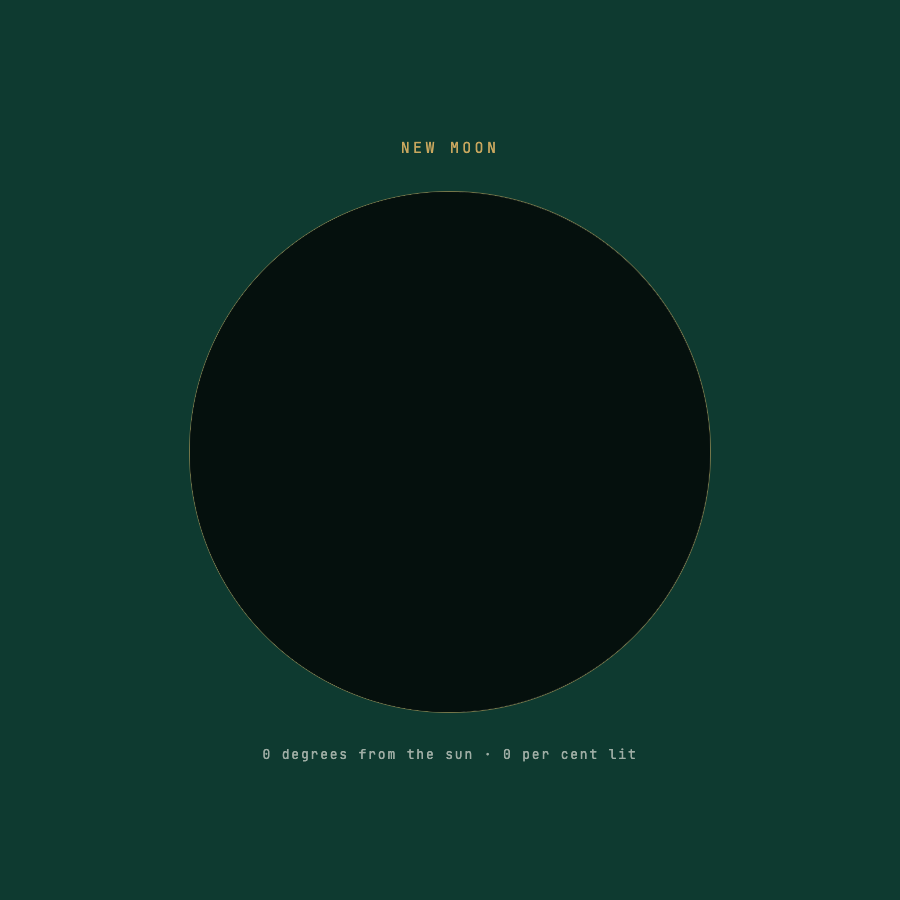
The Moon sits between Earth and Sun, with its lit face turned entirely away from us. It is the one phase you cannot see, and the point the whole cycle is counted from.
- beginning
- invisible
- conjunction
- dark
- reset
What you actually see in the sky
Nothing. This is the honest answer and most pages avoid giving it. At new moon the Moon is in almost the same direction as the Sun, so it rises around sunrise, crosses the sky during the day and sets around sunset, keeping company with the Sun the whole time. Its lit hemisphere faces away from us and the side turned our way is in darkness, lost in daylight glare.
There is no viewing tip that changes this. Looking for a new moon means looking within a few degrees of the Sun, which is dangerous with any optical aid and pointless without one. The only circumstance in which a new moon becomes visible is a solar eclipse, when the Moon passes directly across the Sun's face and is seen as a black disc.
What you can do is watch for its return. Roughly a day after the exact new moon the thin waxing crescent reappears low in the west just after sunset, and spotting that first sliver is a genuine observing challenge with a long history behind it. Anything under about twenty-four hours old is difficult from most latitudes, and the sighting of it is what begins a new month in several calendars still in use.
What the astronomy says
A phase is an angle. Specifically it is the elongation, the angle between the Moon and the Sun as seen from Earth, and at new moon that angle is zero: the Moon lies between us and the Sun. The lit fraction follows from it: illumination is one minus the cosine of the elongation, over two, which at zero gives zero.
This has nothing to do with Earth's shadow. That is a lunar eclipse, a separate and much rarer event which can only happen at full moon, when Earth is between Sun and Moon. Confusing the two is the most widespread misconception about the Moon, and a shadow cannot account for why the cycle takes a month.
A new moon does not produce a solar eclipse every month because the Moon's orbit is tilted about five degrees, so it usually passes above or below the Sun rather than across it. The full cycle from one new moon to the next averages 29.53 days and varies by roughly half a day either side, because the orbit is an ellipse and the Moon does not travel at a constant speed along it. New moon is an instant, and the tool prints the name for six degrees of elongation either side, about eleven hours each way, across which the disc is never a third of one per cent lit. Ask it about a date rather than a moment and it answers as an almanac does, naming a principal phase if its instant falls anywhere in that local day.
What the tradition reads into it
Across almost every tradition that reads the Moon, this phase is assigned to beginnings. Agricultural almanacs, of which the Old Farmer's Almanac has been published continuously since 1792, treated the days after new moon as the time to sow crops that produce above ground, on the reasoning that a waxing moon draws growth upward. No mechanism was ever offered and none has been found.
In modern magical and self-development practice the new moon is the point for setting intentions, and the ritual of writing them down at this phase is now widespread enough to feel ancient. It is not. The specific practice of new-moon intention-setting is largely a late twentieth-century development that spread rapidly online, whatever older material it borrows its vocabulary from.
What the tradition is consistently good at is the structural observation underneath the ritual. A cycle with a defined start gives you a recurring point at which to review something, and the new moon supplies one about every twenty-nine and a half days without anybody having to remember to schedule it. That is a real use, and it does not require the Moon to be doing anything to you. The interval is arbitrary in the sense that any interval would work, and it is not arbitrary in the sense that this one is written on the sky and hard to forget.
How the sign it falls in changes the reading
Phase and sign are two independent facts about the same moment. The phase is the Moon's angle from the Sun; the sign is the Moon's position measured around the ecliptic, and the Moon crosses from one sign into the next roughly every two and a half days.
Because a new moon happens when Moon and Sun share a longitude, a new moon always falls in the sign the Sun is currently in. That is a real constraint rather than a coincidence: a new moon in Aries can only occur during Aries season. Successive new moons land about twenty-nine degrees further on, which is fractionally less than a full sign, so the new moon works its way around the zodiac once a year and returns to any given sign at roughly the same date annually.
This is why the phase and the sign have to be read as two separate pieces of information rather than one. The phase tells you where in the cycle the Moon is, which is a fact about timing. The sign tells you which stretch of the ecliptic it occupies, which changes every couple of days regardless of what the phase is doing. A calculator that reports both is reporting two measurements taken at the same instant, not one measurement described twice, and any interpretation that treats one as implying the other has collapsed a distinction the astronomy keeps quite firmly apart.
What research has actually measured
Two things are worth separating here, because the pillar's credibility rests on getting both right.
The first is that the Moon does not exert a meaningful physical force on a human body. Tidal force falls off with the cube of distance and scales with the size of the object being stretched, which is why it moves ocean basins thousands of kilometres across and does essentially nothing to something under two metres tall. The familiar argument that the Moon moves the tides and people are mostly water does not survive the arithmetic. The tidal effect of the Moon across your body is smaller than that of a person standing next to you.
The second is that large studies have looked hard for lunar effects on human behaviour and not found them. The best-known review, Rotton and Kelly's 1985 meta-analysis of thirty-seven studies, found no reliable relationship between lunar phase and psychiatric admissions, crimes or crisis calls, and later work on birth rates and emergency attendance has been similarly negative. What is better supported is that a bright moon disrupts sleep, and at new moon there is no moonlight at all, which makes this the darkest part of the cycle and the best for seeing faint objects.
Where this meaning came from
The new moon is where most lunar calendars begin, and the practical question of when to declare it has shaped a surprising amount of history. In the Hebrew calendar the month began with the sighting of the first crescent, confirmed by witnesses before a rabbinical court, until the system was replaced by calculation in late antiquity. The Islamic calendar still uses first sighting in many places, which is why the start of Ramadan can differ by a day between countries.
Babylonian astronomers, whose records run from roughly the eighth century BCE, were tracking lunations closely enough to predict them, and their value for the length of the month is remarkably close to the modern one. That work is the direct ancestor of the calculations the tool on this site performs.
The term new moon has quietly changed meaning. For most of its history it meant the first visible crescent, an observable event. In modern astronomical usage it means the invisible moment of conjunction, which is a calculated instant nobody can see. Both definitions are in circulation, they differ by about a day, and a good deal of confusion about when a new moon is follows from nobody saying which one they mean.
The common misreading
The commonest misreading is that a new moon is the Moon in Earth's shadow. It is not, and the difference matters because the shadow explanation is a description of a lunar eclipse, which happens at the opposite point of the cycle. The Moon is dark to us now because its lit side is turned away, not because anything is blocking the light.
The second is treating new moon intentions as a mechanism rather than a practice. Writing down what you want at a fixed recurring moment is a useful habit for reasons that have nothing to do with astronomy: it is a scheduled review with a natural interval. Presenting it as the Moon assisting your plans converts something defensible into a claim that is not, and the honest version is not weaker.
The third is the assumption that a phase says anything about a sign, or the reverse. They are separate measurements. A tool reporting a new moon in Aries is telling you the Moon's angle from the Sun and its position on the ecliptic, and those two facts are not derived from each other. Compare full moon, where the same independence holds and the sign is always opposite the Sun's.
Questions to sit with
- What have you been meaning to start, and what has actually been stopping you?
- If you set a review point every twenty-nine days, what would you want to look at?
- What would you like to be true by the next full moon, and is it in your control?
- What are you calling a beginning that is really a continuation?
See where the Moon is right now.