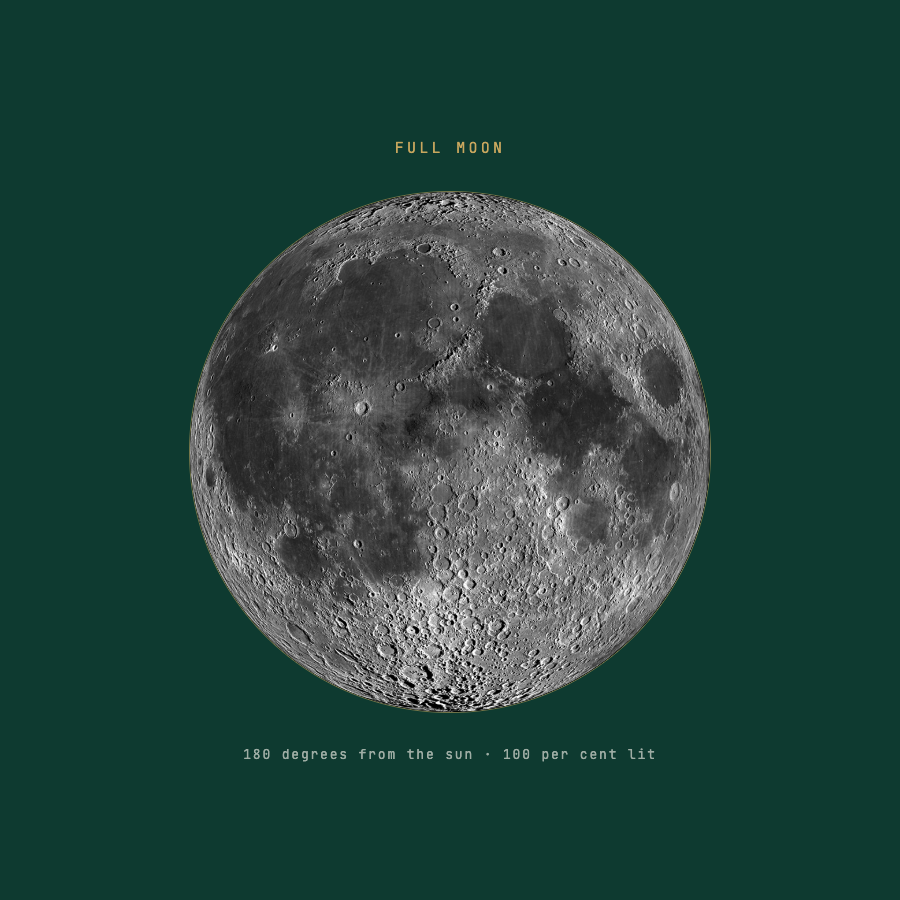
- Phase
- Full moon
- Roughly how much is lit
- 100%
Full moon
The Moon opposite the Sun, fully lit from our point of view. It rises as the Sun sets and sets as the Sun rises, which makes it the only phase visible for the whole night.
- culmination
- opposition
- all night
- visibility
- folklore
What you actually see in the sky
A full moon rises at about sunset, is highest around midnight, and sets at about sunrise. That is the defining practical fact: it is the only phase above the horizon for the entire night, and the only one you can see at any hour of darkness without planning.
Watch it come up if you can. Moonrise at full is worth the fifteen minutes, because the Moon appears enormous near the horizon and shrinks as it climbs. That apparent shrinking is an illusion, and a well-studied one: the Moon subtends almost exactly the same angle throughout, and you can check it by holding an outstretched thumb against it low and high on the same night. Nobody has a fully agreed explanation for why the brain does this.
Through binoculars a full moon is the least rewarding phase, which surprises people. The Sun is almost directly behind you, so nothing on the surface casts a shadow toward you and the craters flatten into a bright glare. What you get instead is contrast between the dark maria and the pale highlands, and the bright ray systems around younger craters like Tycho, which are only obvious at this phase. It is also bright enough to be genuinely uncomfortable to look at through any optical aid.
What the astronomy says
Phase is the angle between Moon and Sun seen from Earth. At full moon that angle is a hundred and eighty degrees: the Moon is opposite the Sun, so the lit hemisphere is the one turned toward us. Illumination is one minus the cosine of the elongation over two, which at a hundred and eighty degrees gives one.
This is the one phase where Earth's shadow becomes relevant, and it is worth being precise. A lunar eclipse happens when Earth passes between Sun and Moon so the shadow falls on the Moon, and that can only occur at full moon. It does not occur at most full moons, because the Moon's orbit is tilted about five degrees and it usually passes above or below the shadow. An eclipse is a full moon; a full moon is almost never an eclipse.
The moment of full is an instant, when the elongation crosses a hundred and eighty degrees. The tool prints the name for six degrees of elongation either side, about eleven hours each way, across which the disc never drops below about ninety-nine and three-quarter per cent lit. The hundred per cent given above is the value at the instant. Ask about a date rather than a moment and it answers as an almanac does, naming a principal phase if its instant falls anywhere in that local day, so the calendar date of a full moon genuinely differs between time zones. The cycle averages 29.53 days, varying by roughly half a day either way because the orbit is elliptical.
What the tradition reads into it
The full moon carries more folklore than the rest of the cycle combined, and most of it descends from one practical fact: before artificial light, this was the only night of the month you could reliably travel, work or gather after dark. Markets, festivals and journeys were scheduled around it because it was the night that worked.
Magical and modern practice reads it as culmination and as the point of greatest available power, and it is the standard time for divination, charging objects and any working concerned with completion. In the almanac tradition the days around full were for harvesting rather than sowing, and for cutting timber, on the reasoning that sap was at its height. No mechanism was ever demonstrated for any of this.
The word lunatic embeds the older and darker version. Belief that the full moon caused madness was widespread enough in English law to survive in statute for centuries, and the Lunacy Act of 1842 still used the term. That is a case where the tradition was not merely unsupported but actively harmful, and it is worth reporting as history rather than as inherited wisdom.
How the sign it falls in changes the reading
Phase and sign are two different measurements of the same instant. The phase is the Moon's angle from the Sun; the sign is where the Moon sits on the ecliptic, and it changes roughly every two and a half days regardless of phase.
At full moon the two are locked together in one specific way. Because the Moon is a hundred and eighty degrees from the Sun, a full moon always falls in the sign opposite the Sun's. A full moon during Taurus season is in Scorpio; during Leo season it is in Aquarius. That is geometry rather than doctrine, and it is why astrological writing calls the full moon an opposition.
It also means the popular question of what a full moon in a given sign means has a hidden constraint: a full moon in Scorpio can only happen at one time of year. The sign is not free to vary independently at this phase, which is the opposite of the situation at the gibbous and crescent stretches, where a phase can begin in one sign and end in another.
What research has actually measured
This is the phase the folklore is about, so the evidence deserves stating carefully rather than briskly.
The Moon exerts no meaningful physical force on a human body. Tidal force falls off with the cube of distance and scales with the size of the object being stretched, which is why it moves ocean basins thousands of kilometres across and does essentially nothing across a person under two metres tall. The familiar argument that the Moon moves the tides and people are mostly water fails on the arithmetic. The tidal effect across your body from the Moon is smaller than that from a person standing beside you, and it does not change with phase in any case, since the Moon's distance is what matters and that varies independently.
Studies have looked hard and found nothing. Rotton and Kelly's 1985 meta-analysis of thirty-seven studies found no reliable relationship between the full moon and psychiatric admissions, crime, or crisis calls, and later work on births and emergency attendance has been similarly negative. The usual explanation for why hospital staff remember busy full moons is illusory correlation: a memorable night that coincides gets stored as evidence, a quiet one does not.
What does hold up better is sleep. Research has found people falling asleep later and sleeping less around the full moon, with the most plausible mechanism being the light itself rather than anything exotic. Replication has been mixed and the effect is modest, but it is real enough to be the sober explanation for a great deal of the folklore.
Where this meaning came from
Two pieces of full moon history are worth getting straight because both are widely misreported.
The named moons, Wolf Moon, Harvest Moon and the rest, are usually presented as Native American tradition. The list most sites reproduce was published by the Maine Farmers' Almanac from the 1930s and popularised much later, and while some names do derive from Algonquian sources, the compilation flattens many distinct nations with different calendars into a single tidy table. Harvest Moon is the exception with a genuinely old English pedigree, and it is defined astronomically as the full moon nearest the autumn equinox, when successive moonrises come unusually close together and give farmers extra evening light.
The blue moon is a documented mistake. The Maine Farmers' Almanac used it for the third full moon in a season containing four. In 1946 James Hugh Pruett, writing in Sky and Telescope, misread that rule and defined it as the second full moon in a calendar month. The error was repeated on a radio programme in 1980, spread widely, and is now the standard meaning. The phrase has nothing to do with colour and never did.
The common misreading
The commonest misreading is that a full moon is Earth's shadow moving off the disc. It is not. The Moon is fully lit because the Sun is behind us and the lit hemisphere faces our way. Earth's shadow reaches the Moon only during a lunar eclipse, a rarer event that happens at this phase and no other. Confusing the two is the most common misconception about the Moon.
The second is the behavioural claim, which deserves meeting directly rather than politely. The belief that full moons produce more births, more crime and busier emergency departments has been tested repeatedly and has not held up. Anybody who works nights will say otherwise, and memory is a poor instrument here: nights that fit the pattern are recalled and nights that do not are forgotten. The sleep finding survives, and it is a claim about light rather than lunacy.
The third is a scheduling error. A full moon is an instant, not a night. The tool prints the name for about eleven hours either side, and the disc stays above ninety-six per cent lit for close to two days each way, so any of those evenings looks full to the eye. If something depends on the exact moment, take it from the tool rather than from a calendar square. Compare new moon, which has the same instant-versus-stretch problem with nothing visible at all, and waning gibbous, which begins straight afterwards.
Questions to sit with
- What has actually come to completion, as against what merely feels loud right now?
- If you sleep badly tonight, what is the most ordinary explanation available?
- What would you notice if you went outside at moonrise instead of reading about it?
- Which of your beliefs about the full moon did you acquire without ever checking?
See where the Moon is right now.