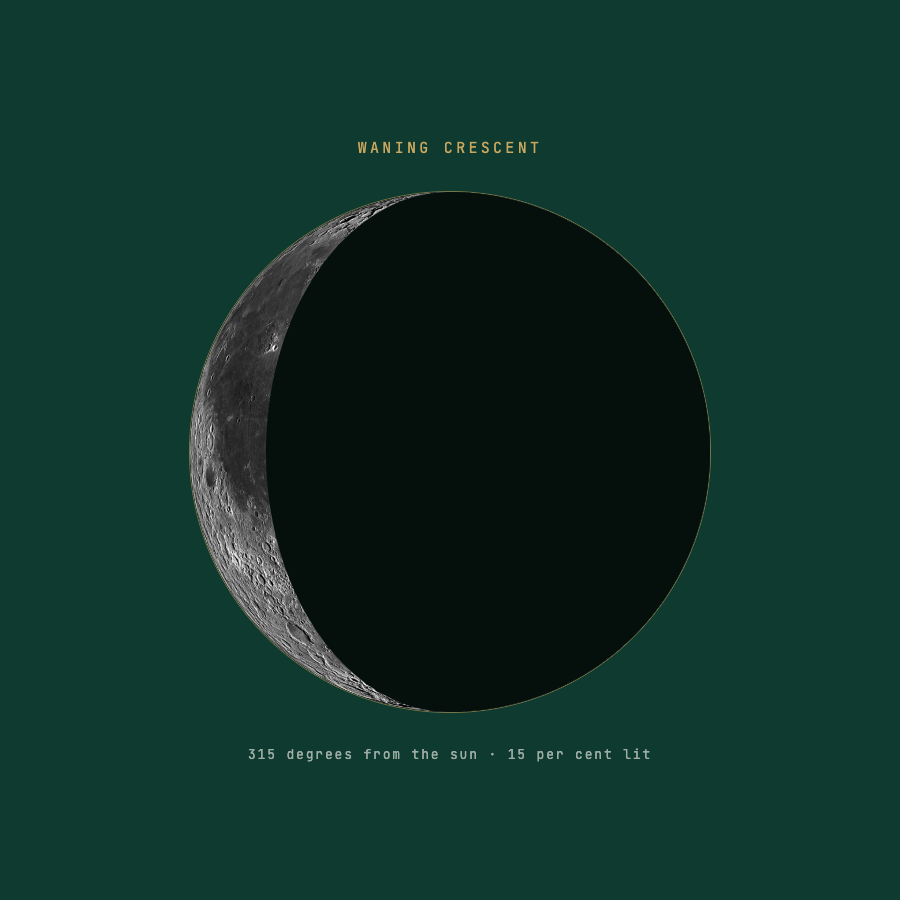
- Phase
- Waning crescent
- Roughly how much is lit
- 49 to 1%
Waning crescent
A thin lit edge before sunrise, shrinking toward nothing. A waning crescent rises in the small hours and is the last visible moon of the cycle before the Moon disappears into the Sun's glare.
- dawn
- thinning
- earthshine
- ending
- last light
What you actually see in the sky
You have to be up early. A waning crescent rises somewhere between about two and five in the morning depending on how thin it is, and it is best seen low in the east in the half hour or so before sunrise, with the sky already beginning to lighten. The thinner it gets, the later it rises and the shorter the window becomes, until the last morning it is lost in the glare entirely.
This is the phase almost nobody sees, and it is the most beautiful one. A thin crescent in a dawn sky, sometimes with Venus or Mercury nearby, is worth setting an alarm for once. Earthshine is at its best here for the same reason it is at the waxing crescent: with only a sliver directly lit, the rest of the disc glows faintly grey from sunlight bouncing off Earth's clouds and oceans. Leonardo da Vinci worked out that mechanism around 1510, long before anyone could photograph the effect he was describing.
In the northern hemisphere the lit edge is on the left, the opposite of a waxing crescent, because the Sun is now rising behind it rather than setting in front. Southern hemisphere observers see it mirrored, lit on the right, and near the equator the crescent can lie horizontally like a bowl. The moon tool draws the northern view.
What the astronomy says
Phase is the angle between the Moon and the Sun as seen from Earth, and here it is closing. The Moon is between roughly two hundred and ninety-three and three hundred and thirty-eight degrees from the Sun, which corresponds to about thirty-one down to four per cent lit, and it is running out of angle as it comes back around toward conjunction.
The dark portion is not Earth's shadow. That is a lunar eclipse, which happens only at full moon and only when the Moon passes through the shadow rather than above or below it. Confusing a crescent with an eclipse is the most common misconception about the Moon, and the giveaway is duration: a crescent lasts days and an eclipse lasts hours. If you can see the unlit part of the disc glowing faintly, that is Earth lighting it, which is the opposite of a shadow.
After this the Moon reaches new moon, the angle passes through zero, and the count restarts. The whole cycle averages 29.53 days, varying by roughly half a day either side because the orbit is elliptical and the Moon travels faster when closer to Earth. The tool derives the age of the Moon directly from the angle, which is why a waning crescent reports as roughly twenty-four to twenty-eight days old.
What the tradition reads into it
This stretch is often called the balsamic moon in modern astrology, a term taken up in the twentieth century for the last few days before conjunction, and it is read as the end of the cycle: rest, retreat, the letting go of what is left rather than the starting of anything.
The older traditions are more concrete and rather less gentle. Almanacs treated the dark of the moon, the last days before new, as unsuitable for planting anything and fit only for clearing, destroying and killing weeds. Folk practice in a number of European traditions associated the same period with banishing work: getting rid of things rather than acquiring them. The consistency across sources probably comes from the same visual analogy that produces the rest of the scheme rather than from any shared origin.
There is also a plainly practical layer. Before artificial light, the last days of the cycle were the darkest nights of the month, and the accounts that survive treat them as the time to stay put. What later became a symbolic instruction to rest and withdraw started, in all likelihood, as the observation that you could not see where you were going.
How the sign it falls in changes the reading
Phase and sign are separate facts about one instant. The phase is the Moon's angle from the Sun; the sign is its position around the ecliptic, and it changes roughly every two and a half days regardless of what the phase is doing.
A waning crescent is between about twenty-two and sixty-seven degrees behind the Sun, so it falls in the sign the Sun is in or the one before it. During Aries season that means Pisces or Aries. It is the mirror of the waxing crescent, which sits the same distance ahead, and both are constrained by the geometry to stay close to the Sun's own sign.
Because the phase band is forty-five degrees wide and the Moon moves about half a degree an hour, this stretch will usually run across a sign boundary during its three and a half days. If you need the sign precisely, take it from the tool at the moment in question, since a rule of thumb cannot resolve which side of the boundary you are on.
What research has actually measured
The evidence on lunar effects is the same at every phase, and the honest summary belongs here as much as on the full moon page.
The Moon exerts no meaningful physical force on a human body. Tidal force falls off with the cube of distance and scales with the size of the object being stretched, which is why it raises tides across ocean basins thousands of kilometres wide and does essentially nothing across a person under two metres tall. The popular argument from the tides to the water in a body fails on the arithmetic.
Large studies have looked for lunar effects on behaviour and not found them. Rotton and Kelly's 1985 meta-analysis of thirty-seven studies reported no reliable relationship between phase and psychiatric admissions, crime or crisis calls, and later work on births and emergency attendance has been similarly negative. The better-supported finding is that a bright moon disrupts sleep, most plausibly because of the light. A waning crescent rises in the small hours and gives almost no light at all, so on that explanation it should be among the least disruptive phases in the cycle, along with the new moon either side of it. These are also the darkest nights of the month and the best for observing anything faint.
Where this meaning came from
The waning crescent has a specific practical importance in calendars that begin the month at first sighting of the new crescent, because it is the phase whose disappearance signals that the sighting is due. Observers watching for the old moon to vanish knew the new month was within a day or two, and in several traditions the last morning the crescent could be seen was recorded as carefully as the first evening of its return.
The term balsamic, now standard in popular astrology for this stretch, is a twentieth-century adoption rather than an old one. It appears in the eight-phase lunation model developed by Dane Rudhyar in the 1960s, borrowed from an older word for a healing balm, and its ubiquity online has given it a false air of antiquity.
The observational tradition of catching the thinnest possible old crescent runs alongside the better-known pursuit of the youngest new one. Both are limited by the same factors: the angle of the ecliptic to the horizon, the clarity of the air near it, and how much twilight has already arrived. Both are a reminder that this cycle was an observed thing long before it was a calculated one, and that the calculation only became authoritative once it could beat a careful observer.
The common misreading
The commonest misreading is that a waning crescent is the same thing as a new moon. It is not. This is a real, visible, thin moon in the pre-dawn sky, and the new moon is the invisible instant when the Moon passes between Earth and Sun. The two get conflated because both are called the dark of the moon in older writing, which was a description of the sky rather than a technical term.
The second is the shadow error, which follows this phase around as it does the other crescent. The dark part of the disc is not Earth blocking the light. Earth's shadow reaches the Moon only in a lunar eclipse at the moment of full, and if anything the unlit portion here is being lit by Earth rather than shaded by it.
The third is treating the tradition's advice to rest as a diagnosis. This is the phase most often used in modern writing to explain low energy, and it is worth being blunt about the direction of the reasoning. If somebody is tired, there are many ordinary explanations, and a symbolic one that arrives on a schedule is the least informative of them. The defensible use is as a recurring prompt to ask what is finishing before new moon restarts the count. Compare last quarter, where the same instruction is given with more light left in the sky.
Questions to sit with
- What is nearly over, and what would it take to let it finish?
- What are you carrying into the next cycle that would be better left here?
- Would you get up before dawn once to see this, and if not, what would be worth it?
- What has this month actually cost you, and was the price the one you expected?
See where the Moon is right now.