- Phase
- Waxing gibbous
- Roughly how much is lit
- 51 to 99%
Waxing gibbous
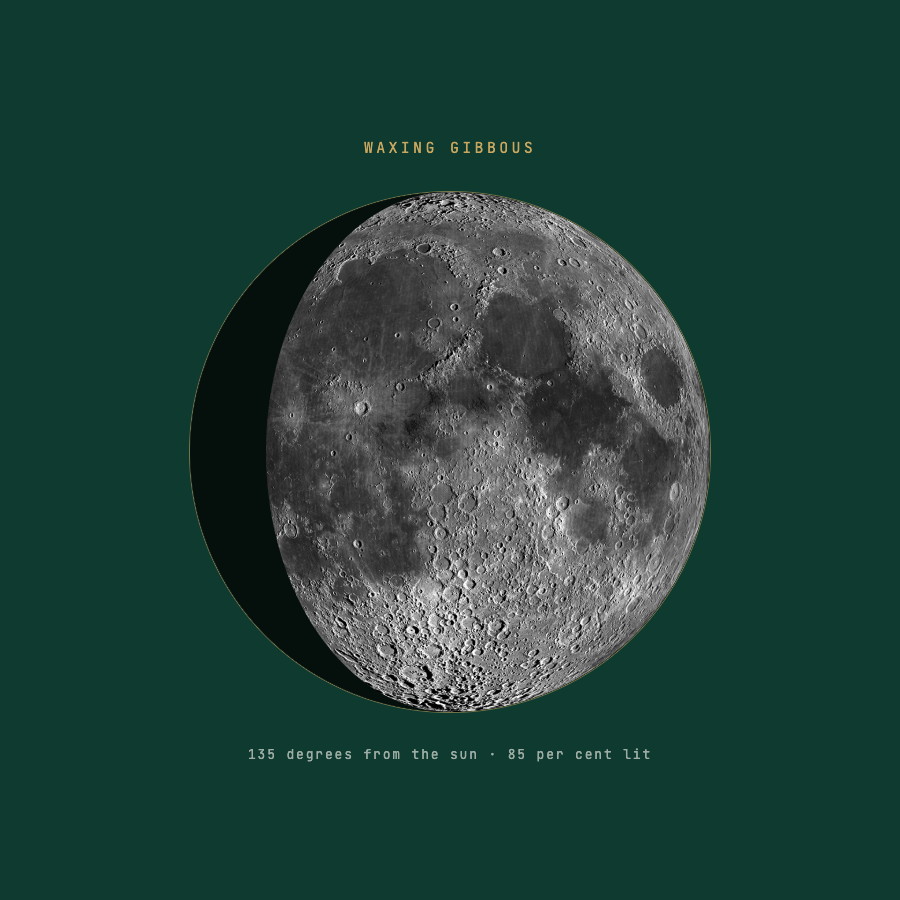
More than half lit and still growing, on the way to full. A waxing gibbous rises in the afternoon and stays up most of the night, and it is the phase people most often mistake for full.
- filling
- gibbous
- evening
- refining
- almost full
What you actually see in the sky
A waxing gibbous is up for most of the evening and well into the small hours. It rises in the mid to late afternoon, is highest somewhere around mid to late evening, and sets in the early hours of the morning. Practically, that makes it the phase you are most likely to see without planning: it is already there when it gets dark, and it stays there.
It is also the phase most often reported as a full moon, and the error is understandable. At ninety per cent lit the disc looks round at a glance, and it takes a deliberate look at the edge to notice that one limb is slightly flattened. In the northern hemisphere the flattened side is on the left; in the southern hemisphere it is on the right, since the whole view is mirrored.
For anybody looking through binoculars, this is the last good stretch before the detail disappears. The terminator is still on the visible face, so craters near it throw long shadows and the relief stands out. As the phase fills, that line retreats toward the edge and the surface flattens into a bright wash. If you want to look at lunar mountains, do it now rather than in three days, when the same features will have washed out completely.
What the astronomy says
Phase is the angle between the Moon and the Sun as seen from Earth, and a waxing gibbous is any moment when that angle lies between about ninety-six and a hundred and seventy-four degrees, which corresponds to roughly fifty-five per cent lit up to almost fully lit. Illumination is one minus the cosine of the elongation, divided by two, and it climbs steeply at the start of this stretch before flattening off near the top.
The word gibbous comes from the Latin for humped, and it simply names the shape: more than half but not yet a full circle. It is one of the few technical terms in astronomy that is doing exactly the job its etymology suggests.
None of this is Earth's shadow. That would be a lunar eclipse, which can only happen at full moon, when Earth sits between Sun and Moon, and which does not happen most months because the Moon's orbit is tilted about five degrees and it usually passes above or below the shadow. What you are seeing is a sphere lit from an angle that is closing on directly behind you. The cycle averages 29.53 days and varies by about half a day either side, because the orbit is elliptical and the Moon does not move at a constant rate.
What the tradition reads into it
The waxing gibbous is the least mythologised phase in the cycle, and that is itself informative. It has no festivals attached, no calendar role, and almost no folklore of its own, because it is neither a boundary nor an extreme. Traditions tend to mark the points that are easy to identify without instruments, and this one is defined by not quite being one of them.
What it does carry, in the systems that use all eight phases, is the language of refinement. The intention was set at the new moon, the first real obstacle appeared at first quarter, and this stretch is read as the work of adjusting and finishing before something is complete. The almanac tradition read the same shape practically, treating the days before full as good for the last cultivation of above-ground crops.
That eight-phase scheme is more recent than it looks. Dividing the lunation into eight named stages with a narrative running through them is largely a twentieth-century astrological construction, set out most influentially by Dane Rudhyar in the 1960s. Older traditions overwhelmingly worked with the four principal phases and treated the stretches between them as unremarkable. Anybody presenting a detailed waxing gibbous ritual as ancient practice is describing something with a very short pedigree.
How the sign it falls in changes the reading
Phase and sign are separate facts about one moment. Phase is the Moon's angle from the Sun; sign is its position around the ecliptic, and the Moon crosses a sign boundary roughly every two and a half days no matter what the phase is doing.
A waxing gibbous sits between about ninety-six and a hundred and seventy-four degrees ahead of the Sun, which is between three and six signs. So it falls four, five or six signs on from whatever sign the Sun is in: during Aries season a waxing gibbous can be anywhere from Cancer through to Virgo.
Because the gibbous stretch runs about six and a half days while the Moon spends only about two and a third days in a sign, a single waxing gibbous will normally cross two sign boundaries. That is the ordinary case rather than an edge case, and it is the clearest demonstration that the two measurements are independent: the phase name can hold across two changes of sign, and the sign can hold across a change of phase name.
What research has actually measured
The evidence is the same at every phase and belongs on every page, not only the dramatic ones.
The Moon exerts no meaningful physical force on a body. Tidal force falls off with the cube of distance and scales with the size of the thing being stretched, which is why it raises tides across ocean basins thousands of kilometres wide and does essentially nothing across a person under two metres tall. The argument from the tides to the water in a human body fails on the arithmetic rather than on the analogy.
Large studies have looked for lunar effects on behaviour and not found them. Rotton and Kelly's 1985 meta-analysis of thirty-seven studies found no reliable link between phase and psychiatric admissions, crime or crisis calls, and later work on birth rates and emergency attendance has been similarly negative. The finding with better support is that a bright moon disrupts sleep, most plausibly because of the light itself. A waxing gibbous is bright and it is up during the hours most people are going to bed, so if there is a real moonlight effect on sleep, this phase and the nights either side of full are where it would show, which makes it a genuinely testable claim rather than a symbolic one.
Where this meaning came from
Gibbous entered English from the Latin gibbosus, humped, and was in use for the Moon's shape by the fourteenth century. It has always been a technical term rather than a popular one, and it is one of the few words that most English speakers encounter only in this context.
Historically the phase mattered less than the four quarters, for a practical reason: the principal phases can be identified by eye with reasonable confidence, and a gibbous moon cannot easily be distinguished from a full one without careful looking. Calendars and observances were built on events people could agree they had seen, which is why lunar months begin at first crescent or at full moon and never here.
The phase became more prominent with photography and with amateur astronomy, both of which favour it. A gibbous moon has the best combination of surface detail and available light for observing, and the illustrations in nineteenth-century lunar atlases were frequently drawn at this phase for exactly that reason. Its low profile in folklore and its high value to observers make an unusual pairing, and it is a reminder that what a culture marks and what is worth looking at are not the same list.
The common misreading
The commonest misreading is calling it full. At ninety per cent lit a gibbous moon looks round to a casual glance, and a great deal of what gets photographed and posted as a full moon is a gibbous one a day or two off. The check is quick: look at the edge, and if one limb is flattened rather than a clean arc, it is not full yet. The moon tool will give you the exact figure.
The second is the assumption that the dark edge is a shadow cast by Earth. It is not, and this is the single most widespread misconception about the Moon. Earth's shadow reaches the Moon only in a lunar eclipse, only at full moon, and only occasionally, because the orbit is tilted. The flattened limb here is simply the part of the sphere that the Sun is not currently reaching from where you are standing.
The third is treating the run-up to full as a period of mounting intensity. The eight-phase narrative that produces that reading is about sixty years old and was presented by its author as a psychological model rather than a discovery. Nothing in the astronomy is building toward anything: the angle is opening at a steady rate and will keep opening straight through full moon without pausing. Compare first quarter, where the same steady opening gets read as a crisis instead.
Questions to sit with
- What is nearly finished, and what is the actual remaining work rather than the imagined version?
- Where are you polishing something that is already good enough?
- What have you been calling done that is closer to ninety per cent?
- If this is not quite complete, who else needs to know that?
See where the Moon is right now.