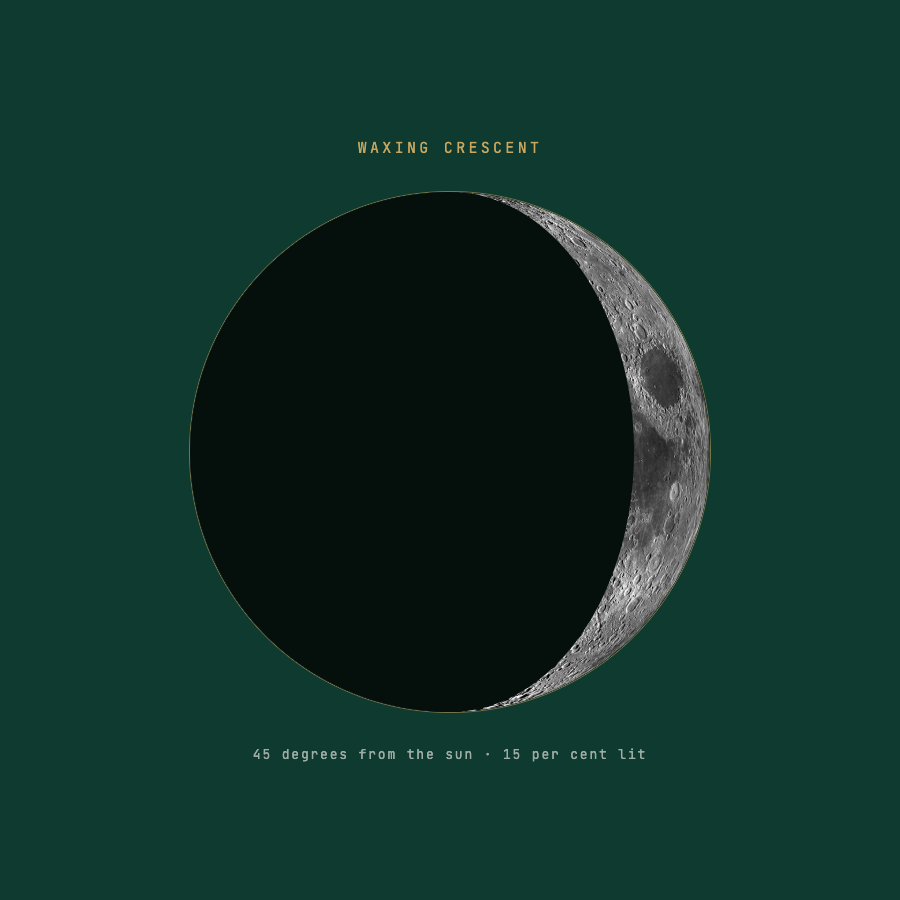
- Phase
- Waxing crescent
- Roughly how much is lit
- 1 to 49%
Waxing crescent
A thin lit edge returning after the new moon, low in the west after sunset. It is the first time in the cycle the Moon is visible again, and it sets soon after the Sun does.
- emerging
- evening
- earthshine
- building
- first light
What you actually see in the sky
Look west, shortly after sunset, and look low. A waxing crescent rises during the morning and sets in the couple of hours after the Sun, so it is only above the horizon in the evening, and it is never far from where the Sun went down. The window is short and it closes earlier the thinner the crescent is.
In the northern hemisphere the lit edge is on the right, facing the Sun that has just set below the horizon. From the southern hemisphere the same crescent appears mirrored, lit on the left, and near the equator it can sit like a bowl with both horns pointing upward. The illustration on the moon tool follows the northern view, which is worth knowing if you are reading this from Sydney or Nairobi and the picture looks wrong.
The detail worth going outside for is earthshine. On a thin crescent you can often make out the whole disc faintly, the unlit portion glowing grey inside the bright arc. That is sunlight reflected off Earth's clouds and oceans onto the Moon's night side. It has an old English name, the old moon in the new moon's arms, and Leonardo da Vinci worked out the cause of it around 1510, several centuries before anyone could photograph it. Binoculars make it obvious, and a clear evening with no haze low in the west makes it obvious without them.
What the astronomy says
The phase is the angle between Moon and Sun as seen from Earth, and here that angle is opening. Having passed the Sun at the moment of new moon, the Moon moves roughly thirteen degrees further along the ecliptic each day while the Sun moves about one, so the gap between them widens by about twelve degrees daily and the lit fraction grows with it.
None of this involves Earth's shadow. A shadow falling on the Moon is a lunar eclipse, which happens only at full moon and only occasionally. What you are seeing here is simply the geometry of which part of a lit sphere is turned toward you, and the terminator, the curved boundary between light and dark, is the line of sunrise crossing the lunar surface.
Because the Moon lags roughly fifty minutes further behind the Sun each day, it is visible for a longer stretch each evening as the crescent thickens. The whole cycle averages 29.53 days, varying by about half a day either side because the orbit is elliptical and the Moon travels faster when it is closer to Earth. On the moon tool a waxing crescent is anything from just after the new moon up to about forty-five per cent lit, at which point first quarter takes over for its brief window. That makes it one of the two longest-named stretches in the cycle, running about six and a half days.
What the tradition reads into it
The waxing crescent is read almost everywhere as the phase of something beginning to take hold. The almanac tradition, which shaped planting practice across Europe and North America for centuries, treated the waxing half of the month as the time for sowing crops that fruit above ground, and this phase in particular as the point when a plan already set should be given its first push.
Magical and folk practice attaches the same shape. Waxing is for building, attracting and increasing; waning is for clearing and releasing. The vocabulary is consistent enough across otherwise unrelated traditions that it seems likely to come from the obvious observation rather than from any shared source: the thing is visibly getting bigger, so it is read as a time for making things bigger.
What is genuinely interesting is how the crescent functioned as a public signal. In calendars that begin the month at first sighting, this phase is not symbolic at all: it is the moment the month starts, confirmed by somebody actually looking. That gave the crescent a civic weight that has largely been lost now the dates are calculated in advance, and it is the reason the shape appears on so many flags.
How the sign it falls in changes the reading
The phase and the sign are separate measurements taken at the same instant. Phase is the angle between the Moon and the Sun; sign is where the Moon sits along the ecliptic, and it changes roughly every two and a half days regardless of what the phase happens to be.
That timing has a consequence people notice and misattribute. A waxing crescent lasts about six and a half days, which is nearly three times as long as the Moon spends in a single sign. So this phase will normally begin in one sign and end two signs later, and readings taken a few days apart can report the same phase in quite different signs without either being wrong.
Because a waxing crescent runs from a few degrees ahead of the Sun out to about eighty-four degrees ahead, it falls in the Sun's own sign or up to two signs beyond it. A crescent during Aries season sits in Aries, Taurus or Gemini, and never further round than that, which is a genuine constraint the geometry imposes rather than a rule anybody chose.
What research has actually measured
The research position on lunar effects is the same at every phase, and it is worth stating plainly rather than only on the full moon page.
The Moon exerts no meaningful physical force on a human body. Tidal force falls off with the cube of distance and scales with the size of the thing being stretched, which is why it raises tides in ocean basins thousands of kilometres wide and does effectively nothing across a body under two metres tall. The popular argument from the tides to the water in a person fails on the arithmetic, not on the principle.
Large studies looking for lunar effects on behaviour have come back empty. Rotton and Kelly's 1985 meta-analysis of thirty-seven studies found no reliable link between phase and psychiatric admissions or crime, and subsequent work on births and emergency attendance has gone the same way. The finding that does hold up better is that a bright moon disrupts sleep, most plausibly because there is more light around in the early part of the night. A waxing crescent sets soon after the Sun, so it contributes almost nothing to that effect, and this is one of the darkest and best stretches of the month for observing.
Where this meaning came from
The crescent is probably the most reproduced astronomical shape in human culture, and its history is mostly civic rather than mystical. In calendars that begin each month with the first visible crescent, sighting it was an administrative act with legal consequences, and the practice survives in the determination of Islamic months, which is why Ramadan can begin on different days in different countries.
The association of the crescent with Islam is later and largely accidental. The symbol was in use in Byzantine Constantinople before the Ottoman conquest of 1453, and the Ottomans adopted an existing municipal emblem rather than a religious one. Its spread as a marker of Muslim identity happened mainly in the nineteenth and twentieth centuries.
The observational history is its own thread. Recording the youngest crescent visible to the naked eye has been a competitive pursuit among astronomers for a long time, and the limits depend on the angle of the ecliptic to the horizon, on air clarity and on the observer. Under about fifteen hours after conjunction, unaided sighting is generally not considered credible, and records claiming less than that are treated with suspicion.
The common misreading
The commonest misreading is that the dark part of a crescent moon is Earth's shadow. It is not. A crescent is a sphere lit from the side and seen at an angle. Earth's shadow reaches the Moon only during a lunar eclipse, at the opposite end of the cycle. If you can see the unlit portion glowing faintly, what is lighting it is Earth, which is the opposite of a shadow.
The second is the manifesting overreach. The waxing half of the cycle is widely presented as a period when effort is amplified, and the tradition genuinely does read it that way, but reporting that as a reason your plans will go better is a claim about the world rather than about a symbol. The defensible version, that a visible cycle gives you convenient recurring markers to work against, survives contact with the evidence. The stronger version does not.
The third is a small factual one that trips up a lot of writing. A waxing crescent is not a moonrise phenomenon. It rises during the day, unnoticed, and becomes visible only once the Sun has set far enough for the sky to darken while the Moon is still above the horizon. Anybody told to watch a crescent rise will be waiting in the wrong direction at the wrong time. Compare first quarter, already high at sunset, and new moon, which cannot be seen at all.
Questions to sit with
- What have you started that is still too small for anyone else to notice?
- What would give the thing its first real push this week?
- Where are you waiting for more certainty before committing, and how much would be enough?
- When did you last go outside deliberately to look at something?
See where the Moon is right now.