- What it is worked out from
- A birth date and a calendar year
The personal year
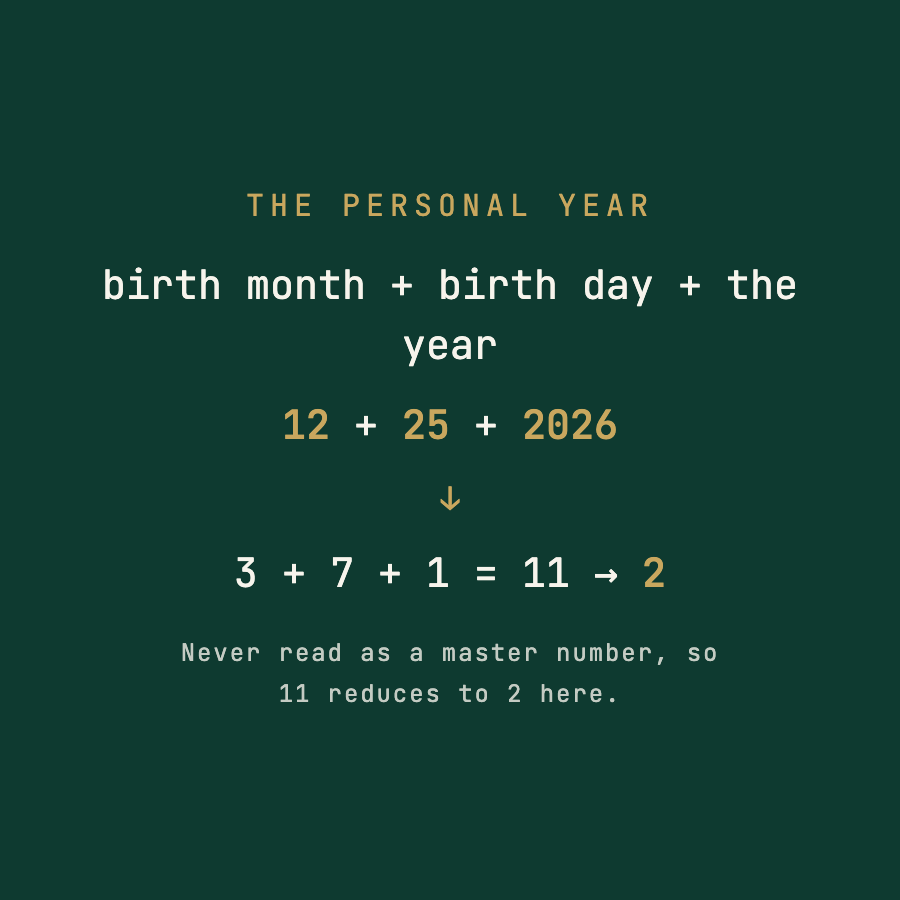
Add your birth month, your birth day and the year you are asking about, then reduce. The result runs one to nine and advances by one each year, which makes it the only figure that is a cycle rather than a fixed trait.
- personal year
- nine-year cycle
- calendar year
- birth month
- cycle position
How the number is worked out
Three numbers go in: your birth month, your birth day and the calendar year you are asking about. Your birth year plays no part, which surprises people and is the main thing that separates this from a Life Path.
Reduce each of the three, add them, and reduce the total. For a birthday of 14 March and the year 2025: March is 3, the 14th reduces to 5, and 2025 reduces to 9 because 2 + 0 + 2 + 5 = 9. Add them: 3 + 5 + 9 = 17, and 1 + 7 = 8. That is a personal year of 8.
The master-number rule is switched off at the end. Whatever the total, it reduces all the way to a single digit, so a personal year is always between 1 and 9 and never 11, 22 or 33. This tool enforces that, and a calculator that hands you an 11 for a personal year has applied the wrong convention.
There is a subtlety in the middle of that. The intermediate reductions do respect masters, so a year like 1993, whose digits sum to 22, contributes 22 rather than 4. It makes no difference to the answer. Substituting a master for its reduced form always shifts a total by a multiple of nine, and multiples of nine leave a final single digit unchanged, so the personal year comes out the same either way.
A worked example
Take a birthday of 4 January and follow it across a decade.
January is 1 and the 4th is 4, so those two contribute 5 every year. The only thing that changes is the year.
2024 reduces to 8, because 2 + 0 + 2 + 4 = 8. Add: 5 + 8 = 13, and 1 + 3 = 4. Personal year 4. For 2025 the year reduces to 9; 5 + 9 = 14, and 1 + 4 = 5. Personal year 5. For 2026 the year gives 10 and then 1; 5 + 1 = 6. Personal year 6.
Run it out: 2020 through 2030 gives 9, 1, 2, 3, 4, 5, 6, 7, 8, 9, 1. The number advances by exactly one each year and wraps from nine back to one. Every birth date produces the same cycle, offset to a different starting point.
That is the whole structure. Someone born on 14 March runs 3, 4, 5, 6, 7, 8, 9, 1, 2, 3, 4 across the same eleven years: the identical cycle, entered at a different point.
Note what happens in 2027, whose digits sum to 11. The intermediate value is a master and is held as 11, and the cycle does not so much as flinch, because eleven and two differ by nine. Checked across every date from 1900 to 2100, the sequence never breaks.
Where the schools disagree
The personal year has two genuine disputes attached to it, and neither is resolved.
The first is when the year turns over. One camp says it changes on 1 January with the calendar. The other says it changes on your birthday, on the reasoning that a personal cycle should start from the personal date. A third position splits the difference and describes a gradual transition through the months around the birthday, which has the advantage of never being wrong and the disadvantage of never being checkable.
The gap between the first two conventions is not small. For someone born in November, the two readings disagree for ten months of every year. This tool uses the calendar year, because that is what the calculation itself uses: the year that enters the addition is the calendar year, and shifting the boundary to a birthday while still adding the calendar year is an inconsistency rather than a variant.
The second dispute is about master numbers. The dominant convention says a personal year is never 11 or 22, because it is a position in a nine-step cycle and a master would have nowhere to sit. A minority hold them anyway. The nine-step structure is the stronger argument, and it is the one implemented here.
What does not affect the personal year at all is the argument that dominates the rest of this calculator. The two Life Path methods, and the 13.4 per cent of birth dates on which they disagree, have no bearing here, because the personal year never uses the Life Path or the birth year. Whichever camp you are in about Life Path 11, your personal year is the same number.
What the number is said to describe
The nine numbers are read as stages of a cycle rather than as traits. One is conventionally a beginning, five a period of change and movement, nine an ending and a clearing-out before the next one begins. The descriptions borrow heavily from the Life Path meanings for the same digits, which is convenient and not obviously justified, since a stage of a cycle and a lifelong disposition are different kinds of thing.
The honest way to use it is as a frame rather than a forecast. A personal year does not cause anything, and nothing about the arithmetic could make it do so: the number depends only on your birthday and the date, so everyone born on the same day of the same month shares it, regardless of age, circumstances or continent.
What it can do is prompt a review on a regular schedule, which is a real use. If a 9 year encourages you to finish things and a 1 year to start them, the value is in the prompting, not in the number.
Where this method came from
The personal year is a later addition than the Life Path, and its origins are correspondingly thinner. It belongs to the same American numerological literature of the early twentieth century, built out from L. Dow Balliett's work of around 1903 and organised, along with the rest, by Juno Jordan in the decades that followed.
Cycles of nine are older than that in Western occultism, and the personal year is best understood as an application of an existing enthusiasm for nine-year periods to a system that was already reducing everything to digits. Nobody appears to have argued for it from first principles.
The Pythagorean label attached to all of this is no better founded here than elsewhere. There is no ancient source that assigns a person a numbered year based on their birthday, and the practice cannot be traced past the twentieth century.
The disagreement about when the year turns over is itself evidence of how the material was assembled. A system designed as a whole would have specified it. A system that accreted leaves the question open, and it has stayed open for about a century.
One small structural point is worth recording, because it is almost never noticed. Because the personal year depends on birth month and birth day but not birth year, it is the one figure in the system that has nothing to do with how old you are. A newborn and their grandparent born on the same day of the same month are in the same personal year, always.
The common misreading
The first misreading is treating the personal year as a forecast. It is arithmetic on a birthday and a date, and it is the same number for everyone who shares your day and month. Anything it appears to predict, it predicts for tens of millions of people at once.
The second is the master number error. A personal year of 11 is not a rare and significant event; it is a calculator that has failed to reduce. The cycle has nine positions and a master number has no place in it.
The third is quiet and does more damage than either. Because the descriptions are borrowed from the Life Path meanings, a personal year reading can end up telling you what kind of person you are this year, which is a category error dressed as a cycle. A 4 year is conventionally about work and structure; that is a suggestion about where to put your attention, not a claim that you have become a different person for twelve months and will change back in January. Compare Life Path 5, whose description is about a disposition rather than a season.
Questions to sit with
- What personal year are you in, and what were you in nine years ago?
- Does the description fit this year better than it fits the same number nine years back?
- Are you using the calendar boundary or your birthday, and did you choose or inherit that?
- If everyone born on your day and month is in the same year as you, what is the number actually telling you?
Run your own date through both methods.