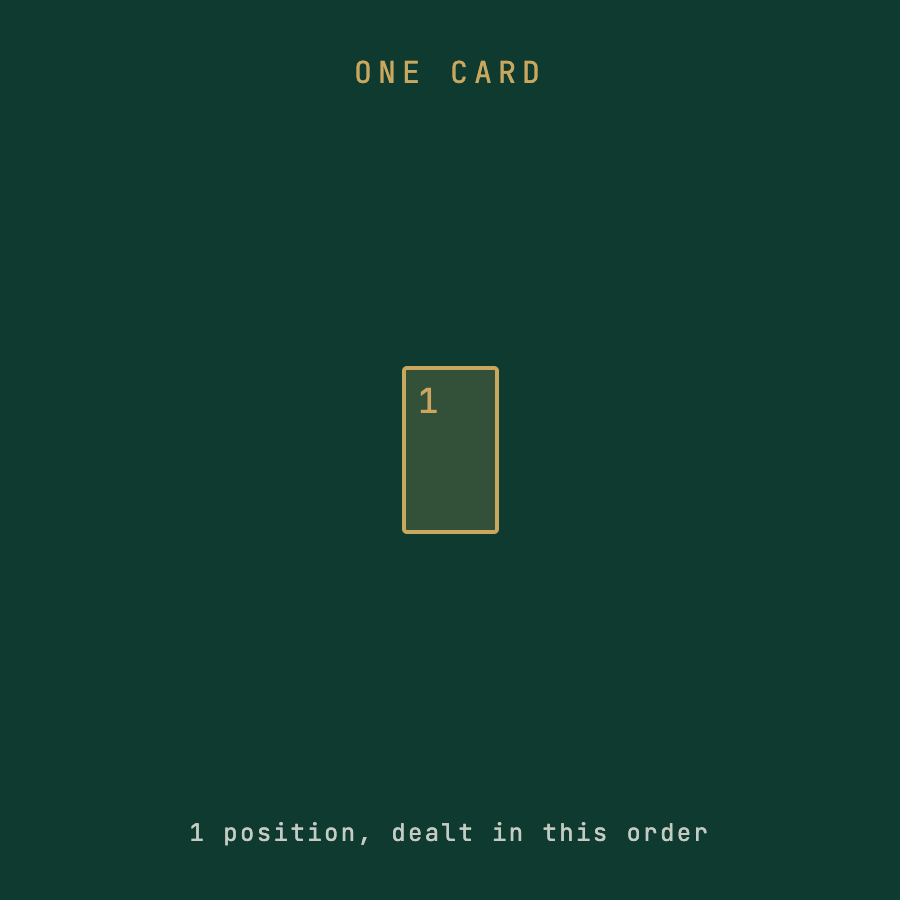
- Number of cards
- 1
- Difficulty
- Beginner
One-card reading
The smallest spread and the hardest to talk your way out of. One card, one question, and no second card to soften the first one when you do not like what it says.
- one card
- single draw
- daily card
- focus
- beginner
When this spread is the right one
A single card suits a question you have already narrowed. Not what should I do about my life, but what am I not seeing about this conversation. The spread does not do the narrowing for you, and a vague question produces a card you can attach to anything.
It is also the right spread for a daily draw, if you keep one. The value there is cumulative rather than individual: thirty cards over a month tell you what you have been preoccupied with, which is more useful than any one of them alone.
Where it does not fit is anything with moving parts. A decision between two jobs, a relationship with two people in it, a situation where the past is doing work on the present. Those need positions, and one card has none. If you find yourself mentally splitting a single card into aspects, you wanted a bigger spread; use the three-card line instead.
It is also a poor choice when you already know what you want to be told, because there is nothing here to average that against.
How to read it
There is only one instruction and it is harder than it sounds: read the card, not your reaction to it.
Start with what is drawn. Say out loud, or write down, what is literally in the picture before you reach for a meaning. This is not a mystical exercise. It slows down the moment where you skip to the keyword you already knew, and it stops the card becoming a mirror.
Then take the card's ordinary range, upright or reversed as it fell, and hold it against the question you actually asked. Most cards read two or three ways. The question decides which of those is live, and if the question was vague, none of them is.
The single-card failure mode is elaboration. With no other card to constrain it, a reader can talk one card into meaning almost anything, and the longer the reading runs the further it drifts from what was drawn. A useful discipline is to finish in three sentences. If it takes more than that, you have started writing rather than reading.
The other discipline is accepting a flat result. Sometimes a card does not connect to the question. Two of Pentacles on a question about grief is probably not a hidden message about grief. It is a card that did not land, and saying so is more honest than forcing it into shape.
Reversals carry more weight here than anywhere else, because there is nothing to average them against. One reversed card is the entire reading.
What each position is asking
The card. The only position in the spread, and the least defined, because it takes its meaning entirely from the question. In a spread with several positions each one narrows what its card can be about. Here nothing narrows it except you.
That has a practical consequence. The quality of a one-card reading is set before the card is drawn, by how precisely the question was framed. Ask what is going on with my career and the card can be about anything at all. Ask what am I avoiding about the conversation I need to have with my manager, and the same card has something to push against.
The position is also silent about time. It does not say past, present or future, and readers routinely supply a tense that was never there. A card drawn on a decision describes the decision as it stands. It does not report what happens after you make it, and if you want a sense of movement you need positions that carry it.
What the position does offer is undivided attention. Ten cards across a table invite you to build a story out of the ones that fit and quietly demote the ones that do not. One card cannot be demoted. If it is unwelcome, it is unwelcome in full, and the whole reading is the work of sitting with that rather than diluting it.
One more thing the position does not carry: a subject. A ten-card spread tells you which card is about the other person and which is about you. A single card is silent on that, and the default assumption, that it is about the querent, is an assumption rather than a rule. It is worth checking, because a card read as a description of somebody else is almost always a description of what the reader thinks about them.
This is also where reversal has the most weight. In a ten-card spread three reversals are noise. Here a reversed card changes everything and there is nothing to check it against, which is why some readers turn reversals off for single draws and read the upright range with more latitude instead.
A worked example
Drawn on this site with reversals on, one card, seed 771402, against the question: should I bring up the thing that has been bothering me.
The card is Two of Cups, reversed. Upright it is two people meeting each other level: mutual, balanced, a partnership of equals. Reversed, the standard range is imbalance, miscommunication, something that has become one-sided.
Against that question this is not an answer about whether to speak. It is a description of the current state: something in the exchange is not level. The card does not say who caused it or who has to repair it, and any reading that assigns blame is being supplied by the reader.
Three sentences, which is the discipline. The connection is currently uneven. The question assumes that unevenness is the thing to raise. The card does not say whether raising it will help.
Note what is absent. No timing, no account of the other person's view, no outcome. A second card would have added a position and therefore a claim. With one card the honest reading stops where it stopped, and the useful move is to go and check the assumption rather than draw again until something friendlier turns up.
Where this spread came from
The one-card draw has no lineage worth claiming, and it is more honest to say so than to invent one.
European cartomancy from the eighteenth century onward used layouts of varying size, and single-card divination appears in that material without ever being codified. Etteilla, working in Paris in the 1780s, produced the first substantial system of tarot fortune-telling and was interested in larger layouts. The Golden Dawn material of the 1890s, which shaped most of what English-speaking readers now use, is likewise concerned with structured spreads rather than single draws.
What made the one-card reading common is much more recent and much more practical. It is fast, it fits on a page, and it fits on a phone. The daily-card habit, which is where most single draws now happen, is a twentieth-century development popularised through mass-market tarot books and then by apps.
None of that makes it less useful. A spread is a way of organising attention, and organising attention around one card is a perfectly legitimate thing to do. It simply is not ancient, and pages that imply otherwise are decorating a good practice with a false pedigree.
The common misreading
The most common misreading of a single card is treating it as a verdict. One card, no context, no positions, and readers still produce sentences like this means you should not do it. The card describes a situation. It does not contain an instruction, and the smaller the spread the more obvious that ought to be.
The second is elaboration. Because nothing constrains a single card, it is easy to talk it into whatever you were hoping for. The tell is length. A one-card reading that runs to five minutes has stopped being a reading and become a monologue with a prop.
The third is redrawing. If the card is unwelcome and you shuffle again, you are not reading, you are sampling until you get a result you like. That is worth naming plainly, because almost everybody does it and almost nobody counts it. The second card is not more true than the first.
And a smaller one: reading a single card as a forecast of the day, which is what the daily-draw habit encourages. A card drawn at breakfast holds no information about your afternoon. What it can do is give you one thing to notice, which is a more modest claim and a defensible one.
The positions, in order
- The card
Questions to sit with
- What exactly did you ask, in one sentence, before you drew?
- Describe what is in the picture before saying what it means. What did you see first?
- If the card had come out the other way up, what would you have concluded?
- Did you want to draw again, and what were you hoping for the second time?
Deal this spread with the full deck.