- Category
- Water
- How common it is
- Common
- Element
- Water
- Matching tarot card
- The Star
The sea
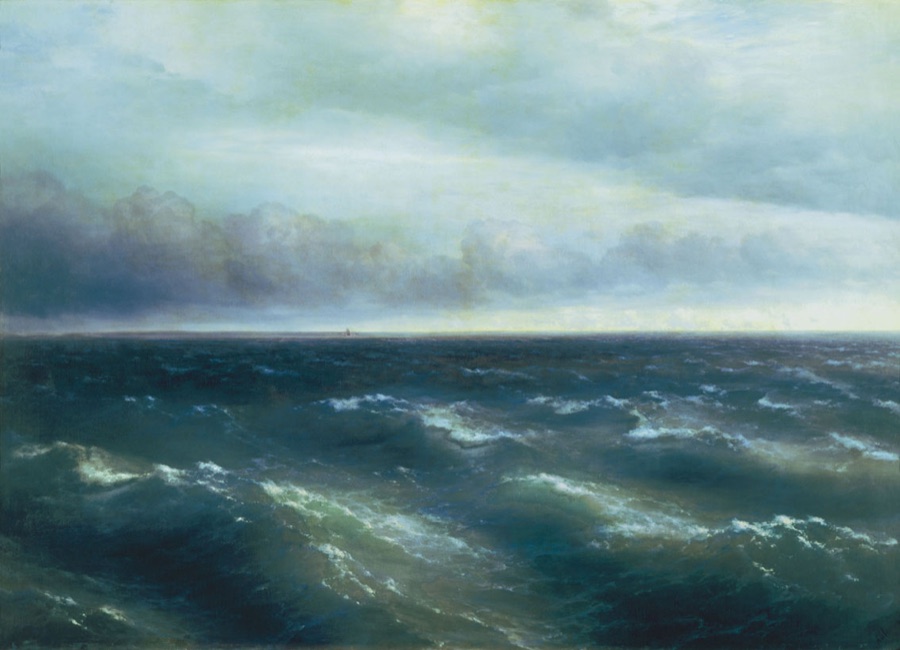
Different from the other water entries in one respect: the sea is too large to be about the dreamer. Most reports are of standing at the edge of it rather than being in it, and that position is the content.
- the sea
- scale
- vastness
- the shore
- perspective
What the dream usually describes
The sea is the water image that does not scale to a person, and that is what separates it from swimming, floods and deep water. A flood is about your house and a swimming dream is about your effort. The sea is not about the dreamer at all, and dreamers describe it in exactly those terms when asked.
What people report most is the edge. Standing on a beach, on a cliff, at a harbour wall, looking out. The dream frequently has no event in it whatsoever. Dreamers describe watching, and describe the feeling as large and difficult to put a word to.
The second consistent detail is the state of the water, and here the reports divide cleanly. A calm sea and a rough sea produce different dreams from the same person, and dreamers almost always volunteer which it was before they mention anything else at all.
The third is direction of attention. Looking out to sea and looking back toward land are different dreams, and dreamers remember which they were doing. That detail is usually more informative than anything about the water itself. See Deep water for the same water at personal scale, and Storms for the weather over it.
The versions people actually report
Standing at the shore looking out is the most reported form by a wide margin. Nothing happens. The dream is the looking.
A calm sea, often at dawn or dusk, is reported as peaceful and occasionally as one of the better dreams the person has had. It is under-represented in dream writing for the usual reason.
A rough or violent sea watched from land is a distinct form, and dreamers describe awe rather more often than fear.
Being on a boat is a different dream again, and the details dreamers report are about the boat and their control of it rather than about the sea.
Waves approaching, particularly one very large one, is a commonly reported and distinctly anxious form. Dreamers usually wake before it arrives.
The tide going out, exposing what was underneath, is a quieter version and is reported with a specific kind of unease that has nothing to do with danger.
The feeling that comes with it
The characteristic feeling is scale. Dreamers reach for words like vast, endless and small, and they are usually describing their own size rather than the water's.
That is unusual. Most dream imagery produces a feeling about a situation. The sea produces a feeling about proportion, and people report it as clarifying at least as often as they report it as unsettling.
Calm-sea dreams are frequently described as among the most peaceful the dreamer has had, and rough-sea dreams as awe-inducing rather than frightening, provided the dreamer was on land.
Fear enters mainly with waves, or with losing sight of the shore.
Worth recording: whether you felt small in a way that was bearable. Dreamers can usually answer that, and the answer varies more than the imagery does.
How the analysts read it
Jung's water symbolism applies here more than anywhere else in this category, and it should be attributed rather than absorbed. He treated the sea specifically as an image of the collective unconscious, the layer he distinguished from the personal one, and the vastness is what does the work in that reading. When a dream site says the sea represents the unconscious, it is quoting Jung at several removes.
Freud read water through birth and infantile material and did not develop the sea as a distinct symbol. The oceanic feeling he discussed in Civilization and Its Discontents (1930) is a separate matter: it was Romain Rolland's phrase for a sense of limitlessness, and Freud reported that he could not find it in himself and was sceptical about what it was taken to prove.
That is worth knowing precisely because the phrase gets attached to sea dreams as though Freud had endorsed it. He did not.
Contemporary practice does not treat the sea as a symbol with a fixed value. Where these dreams recur, the work is usually with the feeling of scale, which is what dreamers actually describe.
What sleep research actually shows
No research establishes a meaning for the sea in dreams, and given how much confident writing exists about this image, saying so plainly matters.
The continuity hypothesis is the honest frame and it is well supported. Dream content tracks waking life: people who live by the sea, work on it, or have recently been near it report more of it. Dream content follows exposure, which is unremarkable and measurable.
The Hall and Van de Castle coding system, published in 1966, established norms for dream settings, and outdoor natural settings appear at consistent and countable rates. Domhoff's later analyses using those norms found individual dream content stable over long periods and closely patterned on a person's own circumstances.
Revonsuo's threat-simulation theory covers the wave and drowning versions and has nothing to say about the calm shore, which is the majority of these reports. That is a limitation of the theory rather than a gap in the dream.
None of this supports a dictionary claim that the sea means the unconscious, or emotions, or the state of your life. There is no measured meaning. The dream is worth reading. The dictionary is the wrong tool for reading it.
How other cultures read it
Greek tradition gives the sea Poseidon and a reputation for danger, and the Odyssey treats it as the obstacle between a man and his home.
Polynesian navigation traditions treat the Pacific as a readable and traversable space, mapped by swell, star and bird, which is close to the opposite framing and is the more impressive achievement.
Norse tradition has the sea as a road and as a boundary at the same time.
In Japanese tradition Ryujin is a dragon deity of the sea, and coastal folklore is populated rather than empty.
Arab and Swahili maritime traditions across the Indian Ocean treated the sea as commercial infrastructure, navigable by monsoon.
The pattern worth noticing is that seafaring cultures do not read the sea as mystery. That framing belongs largely to people looking at it from the shore, which happens to be the position most dreamers report being in.
In a relationship context
In a relationship context, sea dreams are usually about scale rather than about a specific difficulty.
They are reported at points where something has become larger than the day-to-day: a decision about a shared future, a distance, a question about whether two lives actually fit together. The feeling of standing at the edge of something too big to see across is a reasonably direct description of that.
Whether the dreamer was looking out or looking back is worth noting, and it is a fact about the dream rather than about the relationship.
The dictionary readings, that a calm sea predicts harmony and a rough sea predicts conflict, are Victorian forecasts with nothing behind them and are worth ignoring. See An ex-partner.
In a work context
At work, sea dreams tend to arrive at moments of scale rather than of pressure: a career decision, a field that has turned out to be larger than the dreamer expected, a point where the next step is not visible from where they are standing.
They are also reported during periods of genuine possibility, which is unusual in dream reports. Not every dream during a difficult stretch is about the difficulty.
The distinction from a deep water dream is that the sea does not resolve into a personal problem. It is the scale itself that is being registered.
The dream cannot tell you which direction to go, and it cannot assess whether a plan is realistic. See Being lost for the version where scale has become disorientation.
When it keeps coming back
A recurring sea dream is usually stable in setting and variable in the water, and dreamers often find they return to the same stretch of coast. Identifying it is worth doing, because it is frequently somewhere real.
Where the sea changes across successive dreams, from calm to rough or the reverse, that trend is the informative part. Recurring dreams are structurally consistent, so the moving variable is where the signal sits.
If you live by the sea or work on it, recurring sea dreams need no further explanation than the continuity hypothesis already provides.
Recurrent dreams are associated with periods of stress across studied groups and generally ease as the pressure does. That is a group-level observation. If a recurring dream is costing you sleep, raise it with a doctor or a therapist. Only you can describe your own sleep.
When it turns frightening
Sea nightmares usually involve waves, being carried out, or losing sight of land. The fear is about scale and about not being able to get back, rather than about the water itself.
If you have been in danger at sea, or lost somebody to it, nightmares afterwards are common and are a recognised response to frightening events. That is an association and nothing more, and only a clinician who can ask you questions can say anything about your case.
The standard measures apply: regular sleep timing, less alcohol before bed. For nightmares that repeat, imagery rehearsal therapy has reasonable evidence behind it.
If nightmares are frequent, costing you sleep, or began after a traumatic event, speak to a clinician. That is a referral and not an assessment.
Where this meaning came from
Artemidorus treats the sea in the second-century Oneirocritica and, in keeping with his method, reads it against the dreamer's trade. The sea means something different to a merchant than to a farmer, and he says so directly, which is more sophisticated than most of what came after him.
Medieval European interpretation read the sea through scripture, and the storm on the Sea of Galilee gave it a specific theological framing: the sea as what faith crosses.
The Victorian penny dictionaries produced brisk and contradictory entries, in which a calm sea meant good fortune and a rough sea meant trouble, both stated with equal confidence and no evidence at all.
Jung's identification of the sea with the collective unconscious in the twentieth century supplied the reading that now dominates popular dream writing. It is a serious idea inside a framework. It circulates as though it were a measured fact, which is an entirely different thing.
The common misreading
The most common misreading is that the sea represents the unconscious. That is Jung's model, repeated everywhere without attribution and usually with more certainty than Jung himself expressed. It is a framework rather than a finding, and treating it as a finding is the error, not the idea itself.
The second is the calm-good, rough-bad reading inherited from the Victorian dictionaries. It is a forecast, dreams do not forecast, and the reports contradict it anyway: rough-sea dreams watched from land are frequently exhilarating, and calm-sea dreams are sometimes unsettling.
The third is the oceanic feeling, attributed to Freud in a great deal of writing about sea dreams. The phrase was Romain Rolland's, and Freud's response to it was sceptical. Citing him as its author reverses his actual position.
And a smaller one: reading the sea as emotion because water symbolises emotion. That equation comes from popular astrology and tarot rather than from dream research or from either analyst, and it has been imported here without anybody checking whether it belongs.
Questions to sit with
- Were you at the edge, on the water, or in it?
- Was the sea calm or rough, and which did you notice first?
- Were you looking out, or looking back toward land?
- What in your life has recently turned out to be larger than you expected?
Look up the rest of what you dreamed.