- Category
- Journeys and transport
- How common it is
- Very common
- Element
- Earth
- Matching tarot card
- Seven of Cups
Being lost
Somewhere you should know, quietly rearranged. The striking feature of this dream is not strangeness but familiarity that has stopped working, and that one detail is where most of the meaning sits.
- disorientation
- direction
- familiarity
- searching
- uncertainty
What the dream usually describes
You are trying to get somewhere and cannot. The streets do not connect the way they should, the building has too many corridors, the route you have taken a hundred times arrives somewhere else. In most reports there is no threat at all, and no deadline either, which separates this dream from most of the anxiety family.
The detail that matters is that the setting is usually familiar. People rarely report being lost in a genuinely unknown place; they report their own town rearranged, a school that has grown extra wings, a home with a street plan that has quietly changed. That is a different experience from unfamiliarity, and it is the more informative one.
What it tends to describe is a situation where the dreamer's existing knowledge has stopped being sufficient. Not ignorance, which would produce a strange landscape, but obsolescence: a job whose rules changed, a relationship operating on terms nobody restated, a field or a city or a family that has moved while the map stayed the same. Beside missing a train, which has a destination and a clock, this one usually has neither, and the absence of any urgency is the point rather than an oversight in the reporting.
The versions people actually report
The rearranged home town is the base version, and the commonest. Everything is recognisable and nothing connects. People wake from it puzzled rather than frightened, and frequently spend a minute checking the real geography.
The second is the building that will not end: corridors, floors that do not match, doors that lead back. It overlaps with houses with unknown rooms, and the difference is intent. There the dreamer is discovering; here they are trying to leave.
The third is searching for a specific place or person and never arriving. This one carries more distress than the others and clusters around waking situations with something genuinely unresolved in them.
Two rarer forms are worth naming. The version where the dreamer realises they do not know where they were going in the first place, which is usually more unsettling than being unable to get there. And the version where being lost is pleasant, reported by people in periods of deliberate change, which the dictionaries almost never allow for.
The feeling that comes with it
The feeling is usually mild, which is why this dream gets under-reported and under-read. Most people describe frustration, a low background unease, or nothing much at all beyond puzzlement.
That mildness is diagnostic rather than dismissible. A dream that produces confusion instead of fear is telling you something about the shape of the waking situation: not a threat, not a deadline, but a loss of orientation. And when the feeling is stronger than that, when it arrives as real distress, the useful question is what specifically the dreamer was trying to reach, because in the distressing versions there is almost always a destination and it usually maps onto something.
How the analysts read it
Freud's method, set out in The Interpretation of Dreams in 1899, treats the manifest scene as a disguise built by the dream-work and insists that the dreamer's own associations, rather than any list, do the interpreting. On that approach a rearranged childhood town is not a symbol of anything general; it is a specific set of associations belonging to one person, and two dreamers reporting the same street mean different things by it.
Jung read it differently after the break with Freud around 1913. Dreams for him compensate a one-sided conscious attitude rather than concealing a wish, so a person over-invested in knowing exactly where they are going gets a dream that removes the route. He also treated wandering as a recognisable motif with a long history, close to the labyrinth, in which disorientation is a stage of a process rather than a failure of one.
Later clinicians moved away from decoding altogether. Calvin Hall read dreams as conceptions rather than disguises, and Ernest Hartmann would treat the shifting map as an image carrying a waking emotion rather than as a code standing for one.
What sleep research actually shows
No study has established what being lost in a dream means, and no study has tried, which is the honest starting point.
What the field does support is the continuity hypothesis: dream content tracks waking concerns, so this dream clusters around genuine transitions, new roles and periods when a person's usual competence has stopped applying. The Hall and Van de Castle content analyses, from 1966, found that dream settings are overwhelmingly familiar and mundane, which is exactly why the rearranged-hometown version is so common: dreams reach for known places by default, and the distortion is what the dreamer notices. Domhoff's later work, which treats dreaming as an intensified form of mind-wandering supported by the brain's default mode network, predicts precisely that combination of familiar material and loose recombination.
Revonsuo's threat-simulation theory has little to say here, since most reports contain no threat at all, and that absence is itself a useful check on the theory's reach.
None of it supports a dictionary. There is no evidence that being lost signifies one fixed thing. The dream is worth reading, and a symbol list is the wrong tool for reading it.
How other cultures read it
Artemidorus, writing the Oneirocritica in the second century, covered roads and journeys at length and read them conditionally: what a blocked road meant depended on the dreamer's trade, health and obligations. A merchant and a soldier reporting the same dream got different answers, which is the opposite of how the image is handled now.
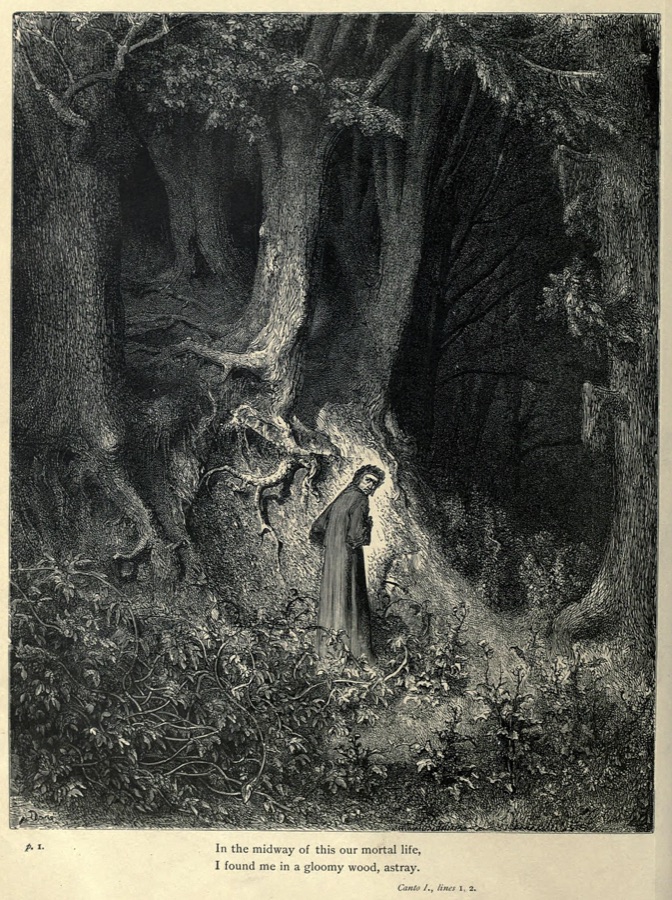
The wandering motif is much older than any dream book. Being lost as a stage of a journey rather than a failure of one runs through the Exodus narrative, through the labyrinth at Knossos, and through the opening of Dante's Inferno, where the poet finds himself in a dark wood having lost the straight road. None of those are dream interpretations, and all of them shape how European readers hear the image.
The medieval dream books attributed to Daniel take the flat approach instead, listing images with fixed outcomes and no reference to who was dreaming, and that is the format the modern dictionary inherited.
In a relationship context
In relationships this dream tends to arrive during undefined stretches rather than during conflict: the period after something changed and before anybody has said what it now is. It is common early, and common again after a long time together when the terms have quietly shifted.
The absence of a destination in most reports is worth taking seriously here. A dream about not knowing where you are going is not evidence that a relationship is going nowhere, and it says nothing about what the other person wants. What it registers is that the dreamer's own map has stopped matching the territory, which is a conversation to have rather than a conclusion to reach alone.
In a work context
At work this clusters around new roles, restructures, career changes and the specific experience of being senior in a place whose rules have changed. It is the dream of competence that no longer transfers, and it arrives more often in capable people than in struggling ones.
The useful distinction is between not knowing the route and not knowing the destination. Those produce different versions of the dream and need different responses: one is a learning problem with a solution, the other is a question about what you are actually trying to do. It is not a signal to change jobs, and no rearranged street has information about your industry or your options.
When it keeps coming back
Recurrence here usually maps onto a stretch rather than a life. The dream tends to run through a period of transition and stop once the new situation has become legible, which people often notice only in retrospect.
What is worth attention is a change in tone. If the dream has moved from puzzling to genuinely distressing, if it is waking you, or if the disorientation is following you into the day, that is worth raising with a doctor. Persistent distressing dreams are associated with a number of conditions, and daytime disorientation has its own quite separate causes that are worth having looked at. Nothing on this page can tell you which, if either, applies to you. You are the only person who can describe what is actually happening, and a clinician is the person to describe it to.
When it turns frightening
The distressing version usually involves searching for a person rather than a place, or a landscape that keeps changing behind the dreamer. Neither indicates that the waking situation is worse than it appears, and both are ordinary intensifications of a mild dream.
If it recurs unpleasantly, imagery rehearsal has the best clinical support for nightmares: writing the dream down while awake, deliberately changing what happens, and rehearsing the new version. It is also worth checking the ordinary explanations first. Vivid unpleasant dreams increase with sleep debt, with alcohol, and with an irregular schedule, all of which disturb the last stretch of the night where most dreaming happens. Compare locked doors, where the obstruction is specific rather than general.
Where this meaning came from
The image is ancient and its treatment has narrowed. Artemidorus read roads and journeys against the dreamer's own circumstances in the second century, which is a method rather than a lookup. The medieval dream books circulating under the name of Daniel replaced that with an alphabetical list of images and fixed outcomes, no dreamer involved, and that format is the direct ancestor of the modern dream dictionary.
The nineteenth century industrialised it. Cheap printed dream books sold in large numbers, many of them designed to convert dream images into numbers to bet on, which is a commercial origin worth knowing before treating the genre as inherited wisdom.
Freud's The Interpretation of Dreams, published in 1899 and dated 1900, broke with the list method and insisted the dreamer's associations were the material. For a dream whose whole content is a personal map, that is not a preference but a requirement, and it is the one thing the dictionaries structurally cannot do.
The common misreading
The first misreading is scale. Being lost in a dream gets delivered as being lost in life, and people take a mild, common dream as evidence of a general crisis. In most reports the feeling is confusion rather than despair, and the waking situation it tracks is usually specific and quite manageable: one arena where the old knowledge has stopped working.
The second is ignoring the familiarity. Nearly every write-up treats the dream as being about the unknown, when the reports themselves are overwhelmingly about known places behaving wrongly. Those are different experiences. A dream about a strange city and a dream about your own street failing to connect are not the same dream, and only the second is common.
The third is refusing the pleasant version. Some people report being lost and enjoying it, usually during deliberate change, and because the format has no category for that it gets recorded as anxiety anyway. Compare an old home, which attracts the same flattening in the opposite direction.
Questions to sit with
- Was the place familiar or genuinely unknown, and how did it differ from the real one?
- Did you know where you were trying to get to, or only that you could not get there?
- Where has your usual competence stopped applying lately?
- Was the feeling confusion, frustration or something closer to relief?
Look up the rest of what you dreamed.