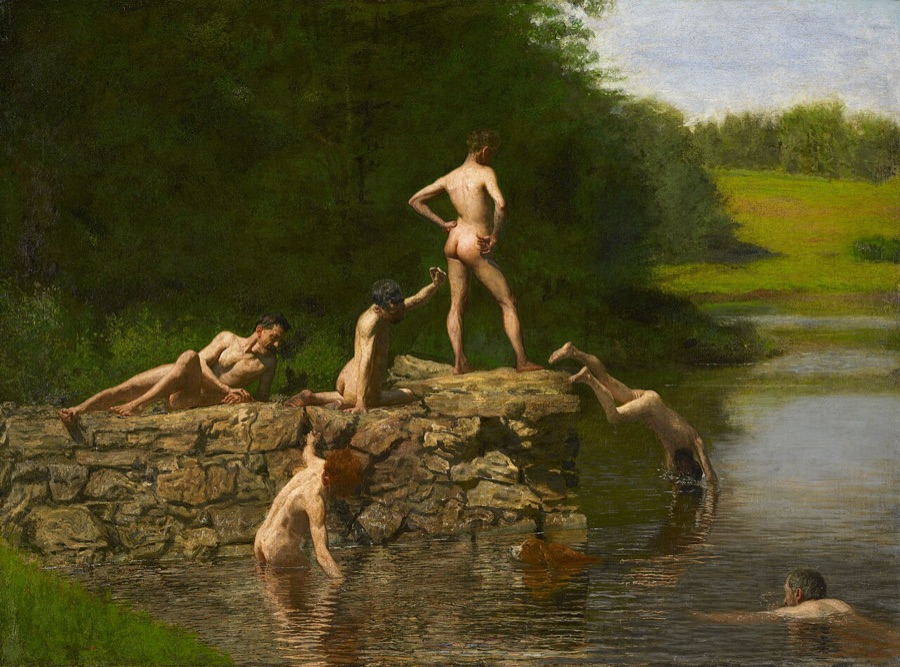
- Category
- Water
- How common it is
- Common
- Element
- Water
- Matching tarot card
- Temperance
Swimming
One of the water dreams people report enjoying, which makes it under-represented in the dictionaries. What the reports turn on is not the water. It is whether the dreamer was making progress through it.
- swimming
- effort
- progress
- water
- competence
What the dream usually describes
Swimming is the active water dream, and that distinguishes it from most of the category. Where deep water is about awareness and floods are about accumulation, swimming is about the dreamer doing something, and the reports are organised around how well it went.
Two variables carry almost all the information. The first is progress: whether the dreamer was moving, and whether the effort corresponded to the distance covered. Swimming hard without advancing is one of the most reported forms, and it reads quite differently from swimming easily, even when everything else in the dream is identical.
The second is the water's condition. Calm water and rough water produce different reports from the same dreamer, and dreamers volunteer this detail without being asked for it. Clear or murky matters here too, though less than in dreams where the dreamer is stationary.
Swimming dreams are frequently pleasant, and that has consequences for the literature. People do not look up dreams they enjoyed, so the dictionaries are built disproportionately out of the difficult versions and then generalise from them. The pleasant ones are still dreams worth reading; they are simply not the ones that generate traffic. See Deep water for the stationary version, and Flying for the same competence in air.
The versions people actually report
Swimming easily in calm water is common and is one of the most positively reported dreams of any kind. It rarely gets looked up, which skews the impression that water dreams are anxious.
Swimming without making progress is the anxiety version and is frequently reported. The dreamer works, the shore does not get closer, and the feeling is futility rather than fear.
Swimming against a current is a distinct form, and dreamers usually describe the current as the antagonist rather than the water.
Swimming toward something specific, a shore, a boat, a person, is reported often, and whether they arrive matters more to the dreamer than anything else in the dream.
Swimming in water that changes underneath them, becoming colder or deeper or rougher, is a version people remember vividly.
And swimming with somebody else is worth noting, because dreamers usually remember whether they were keeping pace or being left behind.
The feeling that comes with it
The dominant reported feeling is competence, which is rare enough in dream reports to be worth stating plainly.
People describe swimming dreams as satisfying, physical and self-directed. That is unusual, and it puts swimming closer to flying than to the rest of the water category.
Where the dream turns difficult, the feeling reported is frustration rather than fear. Dreamers describe effort not producing results, and they usually remember the moment they realised they were not getting anywhere.
Fear, where it appears, is generally about depth or about something else in the water rather than about the swimming itself.
Worth recording: whether you were enjoying it. Dreamers can answer that immediately on waking, and it is the single most useful piece of information in the report.
How the analysts read it
Freud read water dreams through birth and infantile material, and treated emerging from water as a birth image. On swimming specifically he had relatively little to say beyond that frame, and readings presented as Freudian usually extrapolate from elsewhere.
Jung treated water as the image of the unconscious, so swimming in his scheme is deliberate engagement with material the conscious mind does not usually hold. That is a meaningfully different claim from Freud's: it makes the dreamer an agent rather than a subject, which fits the reports better than most analytic readings do.
The two are not variations on one idea, and blending them, which popular writing does routinely, produces a mush in which swimming means both birth and the unconscious and therefore means nothing.
Contemporary practice is more modest. Where swimming dreams recur, therapists tend to ask about the effort and the progress rather than about the water, because that is what dreamers spontaneously report and it maps onto waking situations without requiring any symbolic system at all to do the translating.
What sleep research actually shows
There is no research assigning a meaning to swimming in dreams, and stating that clearly is more useful than implying otherwise.
The continuity hypothesis is well supported and does most of the honest work here. Dream content tracks waking life, so swimmers dream about swimming. That prediction is dull and it holds, and it is the reason a lifeguard's water dreams look different from a non-swimmer's.
The Hall and Van de Castle norms, published in 1966, made it possible to count activities and settings in dream reports, and physical activity appears at consistent rates. Domhoff's later analyses using those norms found dream content stable within a person across years and closely tied to their circumstances.
Revonsuo's threat-simulation theory does not cover this dream, because most swimming reports are not threatening. Pointing that out is not a criticism of the theory. It is a reminder that it was built to explain one part of dreaming.
None of this supports the dictionary claim that swimming means coping, or emotional navigation, or progress in life. There is no measured meaning. The dream still repays attention, and the dictionary is the wrong instrument for reading it.
How other cultures read it
Swimming as a valued skill appears across many cultures, and the associations differ sharply with the local water.
In Japanese tradition, swimming in armour was a martial art with recorded schools, which makes swimming a discipline rather than a metaphor.
Polynesian and Pacific Islander traditions treat swimming and diving as ordinary and highly developed competences, and water there is a worked environment rather than a symbolic one.
Ancient Greek and Roman writing uses the inability to swim as a marker of an uneducated man, which tells you where the value was placed.
In European Christian tradition the strongest water associations are baptismal, and immersion carries a meaning that has nothing to do with locomotion.
What is striking is how rarely swimming carries a fixed symbolic value anywhere. It has usually been treated as a practical skill, which is a useful counterweight to dream writing that treats it as inherently significant.
In a relationship context
In a relationship context, swimming dreams are usually about effort and its results rather than about feeling.
They are reported during periods when a dreamer is working at something: a long-distance stretch, a rebuild after a difficult time, an early relationship taking sustained attention. Whether the dreamer was making progress in the dream tends to match how they feel about that effort.
The version where somebody swims hard and does not advance is worth taking seriously as a description. It is not evidence about a partner's contribution, which no dream can measure, and it is a fairly clear picture of the dreamer's own experience of trying.
If somebody else was in the water, note whether you were keeping pace, as a fact about your dream. See An ex-partner.
In a work context
At work, swimming dreams cluster around sustained effort rather than around crisis.
The productive version, moving well through water, tends to arrive during periods when work is demanding and going reasonably. It is one of the few dream images that shows up when things are working, which is exactly why it is under-discussed.
The version without progress arrives during stretches where the effort is not converting: a role with no visible outcomes, a project that absorbs work and returns nothing, a long run of applications with no replies.
That is worth naming accurately, because it is a specific complaint rather than a general anxiety. The dream describes the ratio of effort to movement, and it cannot tell you whether to keep going. See Stairs.
When it keeps coming back
A recurring swimming dream is worth tracking by outcome rather than by scenery. Do you arrive, and does that change over time.
Dreamers frequently report a series in which the water gets rougher or the distance gets longer, and that trend is more informative than any individual dream. Recurring dreams are structurally stable, so what varies is where the signal is.
If you swim regularly in waking life, recurring swimming dreams are unremarkable, and the continuity hypothesis accounts for them without anything further being needed.
Recurrent dreams are associated with periods of stress across studied groups and generally ease as the pressure does. That is a group-level observation. If a recurring dream is costing you sleep, raise it with a doctor or a therapist. Only you can describe your own sleep.
When it turns frightening
Swimming dreams turn frightening less often than most water imagery, and when they do it is usually through exhaustion rather than through threat: not being able to reach anything, tiring, water that keeps extending.
Drowning dreams are a different category and are reported as considerably more distressing. If you have nearly drowned, or lost somebody to water, nightmares afterwards are common and are a recognised response to frightening events. That is an association, not a diagnosis.
The standard measures apply: consistent sleep timing, less alcohol before bed. For nightmares that repeat, imagery rehearsal therapy has reasonable evidence behind it.
If nightmares are frequent, costing you sleep, or began after a traumatic event, speak to a clinician. That is a referral rather than an assessment.
Where this meaning came from
Artemidorus treats swimming in the second-century Oneirocritica and reads it conditionally, as he reads everything: swimming in clear water is favourable for some dreamers and not for others, and the dreamer's occupation changes the answer. Ancient readings of this image are noticeably less moralised than what came after them.
The medieval European dream books moved water toward baptism and toward the biblical deep, and swimming largely disappeared as a distinct entry, absorbed into water in general.
The Victorian penny dictionaries revived it with characteristic confidence: swimming means success if you reach the shore and difficulty if you do not, and the entries were copied between rival volumes without any examination at all.
Freud and Jung both wrote about water rather than about swimming, and the modern popular reading, that swimming represents coping or emotional navigation, is a late twentieth-century construction attributable to nobody in particular. That is worth knowing when a site states it as established fact.
The common misreading
The most common misreading is that swimming represents how well you are coping with your emotions. It is a modern invention with no source and no support, it is unfalsifiable, and it gets applied to every version of the dream regardless of what actually happened in it.
The second is the shore reading, inherited from the Victorian dictionaries, in which reaching land predicts success and failing to reach it predicts difficulty. That is a forecast. Dreams do not forecast, and the entry was written to sell pamphlets.
The third is the assumption that water dreams are inherently emotional because water symbolises emotion. That equation is a convention of popular astrology and of some tarot systems, imported into dream writing without anybody checking whether it belonged there. Jung's water symbolism is about the unconscious, which is a different claim, and neither is a finding.
And a smaller one: because swimming dreams are frequently pleasant, they get read as straightforwardly good news. They are frequently just pleasant dreams, which is a fine thing to have and is not a message.
Questions to sit with
- Were you making progress, and did the effort match the distance?
- What was the water like, and did it change while you were in it?
- Were you swimming toward something specific, and did you reach it?
- Where in your life is your effort not currently converting into movement?
Look up the rest of what you dreamed.