- Category
- Being chased
- How common it is
- Very common
- Element
- Air
- Matching tarot card
- Nine of Swords
Exams you did not study for
The exam you did not revise for, often in a subject you never took, decades after you last sat one. It is the best-documented anxiety dream there is, and the research on it is genuinely surprising.
- evaluation
- unpreparedness
- exposure
- anticipation
- performance
What the dream usually describes
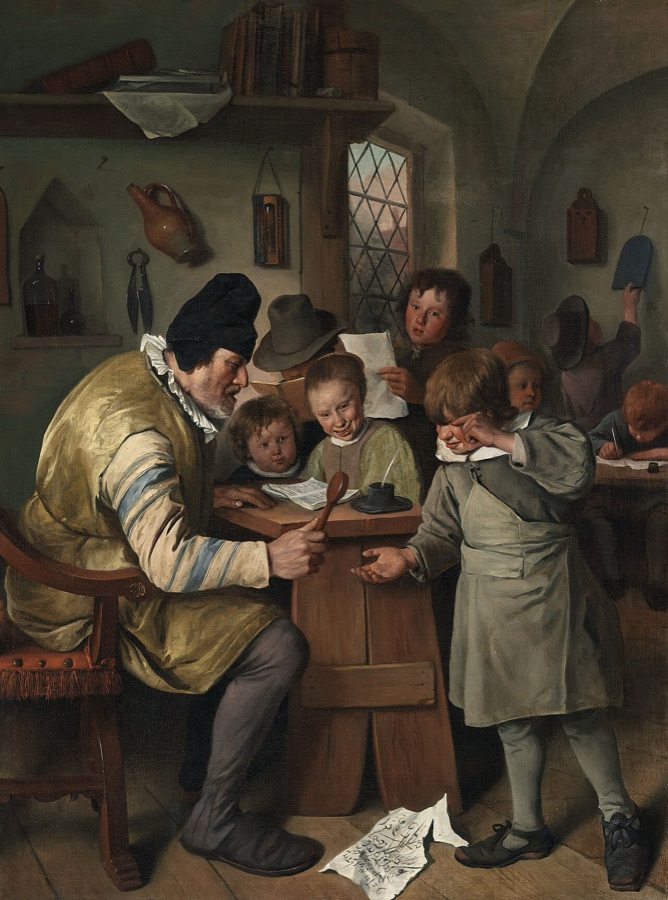
You are in a hall. The paper is in front of you and you cannot answer any of it, or you have arrived late, or you discover you have not attended the course all term. Very often the subject is one you never studied and the institution is one you never attended, and almost always the dreamer left education years or decades ago.
What the dream describes is evaluation you feel unready for. Not failure, which is a different and much less common dream: this one usually stops before the result. The structure is that a test is happening now, the preparation should have happened earlier, and the gap between the two cannot be closed from where you are standing.
The persistence is what makes it interesting. People who have not sat an examination since they were eighteen report this dream in their fifties, which is a problem for any account that reads dreams as simple continuations of daily life. The workable explanation is that the exam is not the subject. Being assessed is the subject, and the exam hall is only the most vivid template most people own for it. Beside being chased it is the same pressure with a deadline instead of a pursuer, and beside a stranger following you it is the same rehearsal in a social register rather than a physical one.
The versions people actually report
The unprepared paper is the base version: the questions are legible, you have never seen the material, and there is a clock. People wake from it with the specific sensation of having been found out rather than of having failed.
The second is logistical rather than academic. You cannot find the room, the exam started an hour ago, you have the wrong timetable, or you overslept. That variant maps onto waking life more directly and tends to arrive when somebody is genuinely behind on something.
The third is the term you did not attend, discovered at the end of it. This one carries a different flavour, closer to dread than to panic, and is reported disproportionately by people who have been avoiding a piece of work rather than merely running late with it.
Its closest relative is being naked in public, the same exposure without a deadline attached. Rarer forms worth naming: the paper in a language you cannot read, the pen that will not write, and the version where you realise partway through that you already hold the qualification and should not be in the room at all, which usually wakes people up.
The feeling that comes with it
The feeling is exposure rather than fear. This dream is not frightening the way a pursuit dream is frightening; it is mortifying. The dominant report is of being about to be seen as unprepared, in public, by people whose opinion counts.
That is why the feeling matters more than the setting. The hall, the paper and the clock are stage furniture and they vary. What does not vary is the social sensation of a gap between what you are expected to know and what you actually know, about to become visible. If you want to know what an exam dream is about, do not ask what the subject was. Ask where you are currently at risk of being found out, and most people have the answer ready.
How the analysts read it
Freud gave exam dreams a specific and counterintuitive treatment in The Interpretation of Dreams, and it is worth knowing because it contradicts the way the dream is usually read. He observed that people dream of examinations they have already passed, and, crediting Wilhelm Stekel, argued that such dreams console rather than threaten: the mind reaches for a past dread that turned out to be groundless in order to steady the dreamer against a present one. On that account the dream is saying you were frightened before and it was fine.
Jung read it differently, as he read most things after the break with Freud around 1913. For him a dream compensates a one-sided conscious attitude, so an examination dream corrects an inflated self-assessment: the dreamer has been more confident than the situation warrants and the psyche supplies the test. He also treated examination imagery as a version of the older initiation motif, in which a person is measured before being allowed to pass.
Later clinical work is much less interpretive. Calvin Hall treated dreams as conceptions rather than disguises, and Ernest Hartmann would read the exam hall as a contextualising image for a waking emotion rather than as a coded message about anything.
What sleep research actually shows
The best study on this dream is unusually direct. Isabelle Arnulf and colleagues, publishing in Consciousness and Cognition in 2014, surveyed several hundred French medical students on the morning of a highly competitive entrance examination. Around three fifths had dreamed about the exam, and the overwhelming majority of those dreams contained a problem: arriving late, oversleeping, a blank paper. The students who dreamed about the exam, including those whose dreams went badly, scored better on the actual paper than those who did not. That is a correlation rather than a demonstration of cause, and the authors were careful about saying so.
Theoretically the dream sits awkwardly. Revonsuo's threat-simulation theory explains rehearsal of physical danger, and a written examination is not an ancestral threat; the better fit is the social simulation theory he later developed with Tuominen and Valli, which extends the rehearsal idea to social and evaluative situations. The continuity hypothesis, supported by the Hall and Van de Castle content analyses and by Domhoff's later work, accounts for the persistence: what continues is a concern with being assessed, not with schooling.
None of this supports a dictionary. There is no evidence that an exam stands for one fixed thing. The dream is worth reading and the symbol list is the wrong tool for reading it.
How other cultures read it
This dream has an unusual problem for a dream symbol: the experience behind it is recent. Mass formal examination is a nineteenth-century development in Europe, which is why the medieval dream books carry no entry for it. The symbol postdates the dictionaries that claim to explain it, and that is worth noticing about the genre as a whole.
The exception is China, where the imperial civil service examinations ran from the seventh century until they were abolished in 1905. Examination anxiety is a long-running subject in Chinese writing, and satires such as The Scholars in the eighteenth century turn on lives organised entirely around the exam hall. Dread of that room is not a modern import there.
Artemidorus, writing in the second century, has nothing on examinations either, but his method covers the case: he read every image against the dreamer's occupation and standing, which is exactly how anybody would have to read a dream about being tested.
In a relationship context
In a relationship context this dream usually arrives around being assessed by somebody rather than around conflict with them. Meeting a partner's family, a first stretch of living together, a period in which the relationship feels probationary.
It is also common during a stretch when one person suspects they are being compared with somebody else, although the dream cannot confirm that and should not be used to. What it describes is the dreamer's sense of being under evaluation. It has no access to whether anybody is actually evaluating them, and reading it as evidence that a partner is judging you is how a manageable insecurity turns into an argument.
In a work context
This is where the dream lives for most adults. Reviews, probation, a new role, a presentation, a promotion that has not been confirmed, any situation where competence is about to be inspected by somebody with authority over the outcome.
The useful detail is that it clusters before the event and largely stops afterwards, whatever the result was. That pattern says the dream is about anticipation rather than about consequence. It is not a signal that you are underqualified, and the research points mildly the other way, since the students who dreamed about the exam did better on it. Treat it as a report on how exposed you feel, not as an assessment of whether you should.
When it keeps coming back
This is one of the most commonly recurring dreams there is, and in most people it recurs for decades without indicating that anything is wrong. It tends to cluster around periods of evaluation and to go quiet in between, so the pattern across a year is more informative than any single instance.
What is worth attending to is a change in the pattern. If the dream arrives nightly rather than in clusters, if it wakes you and you cannot get back to sleep, or if it is carrying real distress into the following day, that is worth raising with a doctor. Persistent distressing dreams are associated with several conditions including anxiety disorders, and nothing here can tell you whether that applies to you. Only you can describe your own sleep, and a clinician is the person to describe it to. Compare missing a train, which clusters the same way.
When it turns frightening
The distressing version is usually the one where the dreamer cannot leave: the paper will not end, the room will not let them out, the time keeps extending. That trapped variant is considerably more unpleasant than the ordinary unprepared version and does not indicate anything worse underneath it.
Practically, the measures that help other anxiety dreams help here. Imagery rehearsal, in which a person writes the dream down while awake and deliberately rewrites the ending, is used clinically for recurrent nightmares. Sleep debt and alcohol both make vivid unpleasant dreams likelier by disturbing the last stretch of the night. If exam dreams have become worse rather than simply more frequent, look at what changed about the sleeping before looking at what changed about the life.
Where this meaning came from
Because formal examination is recent, this dream has no long interpretive lineage, and the absence is itself informative. Artemidorus wrote the Oneirocritica in the second century and covers a very wide range of images conditionally, according to who was dreaming. The medieval dream books that circulated under the name of Daniel list images alphabetically with fixed outcomes attached, and have nothing whatever to say here, because the experience did not exist yet.
The nineteenth-century penny dream books, sold cheaply and often designed to convert dream images into numbers to bet on, are the commercial ancestor of the modern dictionary. They were being printed at exactly the moment mass schooling was creating this dream in the first place.
The first serious treatment is Freud's, in 1899. His reading, that examination dreams console rather than threaten, is still the most interesting thing anybody has said about them, and almost no modern dream site mentions it.
The common misreading
The first misreading is treating the dream as a verdict on competence. It gets delivered as evidence that somebody is not ready, or is out of their depth, and people have turned down opportunities on that basis. The dream describes the feeling of being about to be assessed. It has no access to how good anybody is at anything, and the one direct study points mildly the other way.
The second is over-literalising it. Dreaming of a chemistry exam says nothing about chemistry, and dreaming of school says nothing about unfinished business with school. In most adults the setting is simply the oldest and most vivid template available for evaluation, borrowed for a situation with no connection to education at all.
The third is the reassurance reading, which is the mirror error. Because Freud called these dreams consoling, some write-ups now deliver them as a sign that everything will be fine. That is not what the claim says, and no dream can promise anybody an outcome. Compare teeth falling out, which attracts far more confident interpretation on a much thinner evidence base than this one has.
Questions to sit with
- Where are you currently at risk of being found out, and by whom?
- Did the dream stop before the result, or did you actually see one?
- What is coming up that you have prepared for less than you meant to?
- How long is it since you sat a real exam, and what has taken its place?
Look up the rest of what you dreamed.