- Kind of topic
- Practice
Keeping a dream journal
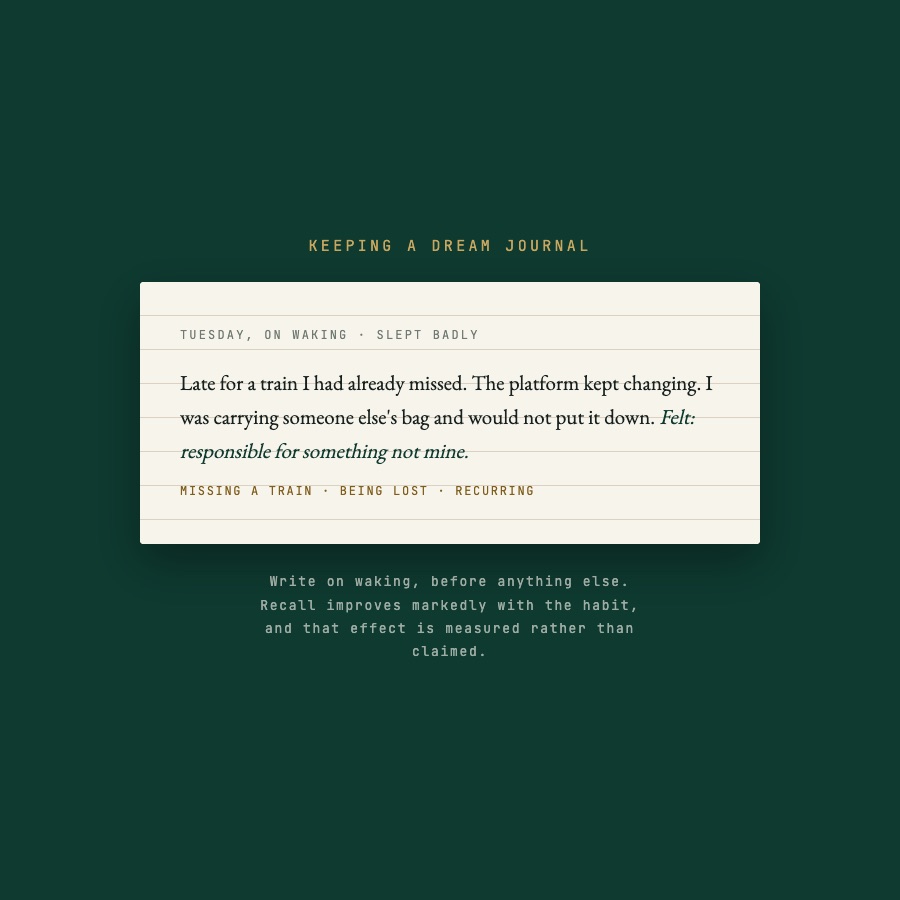
A dream journal is a record, not an interpretation. It is also the one practice in this field with solid evidence behind it: recall improves markedly within a couple of weeks of writing on waking, and that effect has been measured rather than claimed.
- recall
- record
- practice
- evidence
- attention
What it is
A dream journal is a written record of what you remember on waking, made before the memory degrades and before you have started explaining it. That is the whole of it. Interpretation, if there is going to be any, happens later and separately, and running the two together is the commonest way the practice goes wrong.
It is worth saying what it is not. It is not a diary, and the day's events belong in it only as one line of context. It is not a record of interpretations. And it does not have to be daily to be useful: a record kept four mornings out of seven for two months is a considerably better instrument than a perfect fortnight followed by nothing at all.
The reason for keeping writing and thinking separate is practical. A dream memory is unusually fragile. It degrades within minutes of waking, and it degrades faster once you begin narrating it, because the narration quietly replaces the original with a tidier version that is what you will remember from then on. Writing first and thinking afterwards protects the material.
What accumulates is more useful than any single entry. One dream is close to unreadable. Twenty dreams across a month show recurring settings, with an old home turning up in three of them, recurring characters, a characteristic emotional register, and the specific week in which all of that shifted. Those patterns are visible in a notebook and invisible in memory, which is the real argument for keeping one.
It is also, incidentally, exactly what dream researchers do. The norms that content analysis rests on were built from written dream reports collected in much the same way, and the large public archives of coded dreams are, at bottom, collections of journals that people kept. Somebody with a notebook by the bed is running a very small version of the standard method in the field.
How to do it
Keep whatever you are writing with within arm's reach of where you sleep, and decide in advance what it is. The single largest failure mode is getting up to find a pen, because the memory does not survive the walk.
Paper or phone is genuinely a matter of what you will actually use, with one caveat. A phone screen at four in the morning is an alerting stimulus, and unlocking it tends to pull you further out of the state you are trying to record from. If you use one, have the note already open and the brightness low. A voice memo is the fastest option of all and the one people abandon soonest, because a month of recordings is close to unsearchable.
Write immediately, before speaking to anybody and before looking at anything. Use the present tense: I am in a house I do not recognise, rather than I was in a house. The present tense keeps you inside the memory instead of summarising it from outside, and it noticeably increases how much comes back while you are writing.
Include the parts that make no sense and do not smooth the joins. The incoherent transitions are data. So is the fact that somebody in the dream was also somehow somebody else, which is a common and specific feature that a tidied account always loses.
Record the feeling separately from the events, in one line: frightened, embarrassed, calm, urgent, indifferent. Emotional tone is the most stable thing about a dream and the first thing to vanish from a retelling.
Note the date and one line about the previous day. That line is what makes a journal readable a month later, because it lets you set the dream against what was actually happening at the time. Without it you have a collection of images and no way to test them against anything.
If nothing comes back, write the date and the word nothing, and do it anyway. Recall responds to the expectation of recording, and the empty entries are part of what produces the full ones. Two weeks is usually enough to see the change.
What research has actually measured
This is the one practice on the site with real evidence behind it, and the evidence is about recall rather than about meaning.
Dream recall improves substantially with the habit of recording. The effect shows up in studies comparing people who keep logs against those who do not, and in within-person designs where recall rises after the practice begins. Two mechanisms are usually offered: attention, because expecting to record something makes you more likely to attend to it on waking, and encoding, because writing consolidates a memory that would otherwise decay within minutes. Both are ordinary memory effects, and neither requires anything unusual to be true about dreams.
Recall is also strongly determined by when you wake. Laboratory awakenings from REM sleep produce dream reports the large majority of the time. Awakenings from non-REM sleep produce them considerably less often but by no means never, which is why the old equation of dreaming with REM has been abandoned. People who wake naturally in the night, or who wake at the end of a REM period rather than out of deep sleep, recall more, and that accounts for a good deal of the individual variation people take to be a fixed personal trait.
One caveat runs underneath all of this. A dream report is a memory of a dream, produced while awake, in language, and it is not the dream. Reports get smoothed into narrative, gaps get filled in, and the final portion is over-represented because it decayed least. Everything the field knows about dream content is downstream of that limitation. It is a reason to write quickly, and a reason not to treat any single account as exact.
What the evidence does not support is any claim about what the recorded dreams mean. Journaling produces better data. It does not produce interpretation, and no amount of recall makes a fixed-meaning lookup more valid than it was. Why dream dictionaries do not work covers that separately.
How the traditions differ
Written dream records are a great deal older than psychology. The most striking surviving example is the diary of Myoe, a Japanese monk of the Kegon school, who recorded his dreams across roughly forty years in the late twelfth and early thirteenth centuries. It is among the longest continuous dream records in existence, and it was kept as a religious discipline rather than as self-analysis.
The purpose differs sharply between traditions, and the difference matters more than the practice does. Myoe recorded dreams as encounters. Artemidorus collected other people's dreams as evidence, travelling to gather them and asking afterwards what had happened. Freud recorded his own as data for a theory. Jung recorded his as an ongoing conversation with something he took to be a genuine other.
What all four have in common is the writing rather than the framework. That is a reasonable argument for keeping the record and staying agnostic about the theory, which is roughly where the evidence sits in any case.
Where it came from
The systematic collection of dreams starts with Artemidorus in the second century CE, who describes travelling to gather dream reports and to find out what happened to the dreamers afterwards. Whatever one makes of his conclusions, the method is recognisably empirical: collect, record, compare.
The modern practice begins with Freud's self-analysis in the 1890s. Die Traumdeutung, published in 1899, is built substantially on his own recorded dreams, and the specimen case he opens with is a dream of his own from the night of 23 July 1895. The method the book sets out assumes a written record, because without one there is nothing for free association to start from.
Jung kept dream records throughout his life and treated a series as the unit of analysis rather than any single night. That is a specific methodological claim, and later content research supports it for entirely unrelated reasons.
The empirical phase begins with Calvin Hall, who from the 1940s collected dream reports in bulk in order to count what was in them rather than to interpret them. That collecting habit produced the norms the field still works from, and the archives now available to researchers exist because ordinary people wrote their dreams down.
The common misreading
The commonest misreading is treating the journal as a decoding exercise. People write the dream and then immediately write what it means, and the second act contaminates the first. Within a week the notebook contains interpretations rather than dreams, and the raw material the practice was meant to preserve has gone. Keep them on separate pages if the temptation is strong.
The second is the completeness trap. A journal kept only when the dream was vivid and the morning unhurried is a biased sample of exactly the wrong kind, over-weighted toward the dramatic, so that a notebook can end up looking like nothing but being chased and falling. Short entries and blank entries are what make the record usable, and a notebook full of two-line fragments is worth considerably more than one with six polished accounts.
The third is the belief that some people do not dream. Sleep laboratory work is clear that dreaming is close to universal. What varies enormously is recall, and recall is the thing that responds to practice. Somebody who has never remembered a dream is describing their waking rather than their sleeping, and a journal is the intervention most likely to change it. That is also why the lucid dreaming literature treats a journal as the first step rather than as an optional extra.
Questions to sit with
- What is the first thing you do on waking, and does it happen before or after you would have written?
- Which settings or people have turned up more than once this month?
- What was the feeling, in one word, before you describe anything that happened?
- What was going on in the day before the dreams you remember most clearly?
Look up what you actually dreamed.