- Kind of topic
- Research
Nightmares and what research shows
Nightmares are common, they are better understood than most of this subject, and there are treatments with real evidence behind them. What follows is what research has measured. It is not a diagnosis and cannot be one.
- nightmares
- night terrors
- threat simulation
- prevalence
- treatment
What it is
A nightmare, in the technical sense, is a frightening dream that wakes the sleeper, who is then oriented and able to recall it. Each part of that matters, because it separates nightmares from two things they are regularly confused with.
Night terrors are different. They arise out of deep non-REM sleep rather than REM, usually in the first part of the night, and they involve intense arousal with very little dream content. The person may sit up, cry out, or appear awake and inconsolable, and typically remembers nothing afterwards. They are common in young children and mostly resolve with age. Somebody who wakes screaming and cannot say why has probably not had a nightmare in the technical sense.
Sleep paralysis is different again. It is the brief persistence of REM muscle atonia into waking, so that a person is conscious and unable to move, often with a sense of a presence in the room and pressure on the chest. It is frightening, it is physiologically well understood, and it is not a dream, although the imagery accompanying it behaves like one.
Ordinary nightmares occupy the REM-heavy second half of the night, which is why they cluster toward morning, and they sit on a continuum with ordinary bad dreams rather than forming a separate species. The clinical distinction is not about how vivid or how horrible the content was. It is about whether the dream wakes you, and whether it is causing a problem in waking life.
How to do it
There are two separate questions here and they should not be run together: what is reasonable to do about an occasional nightmare, and what to do about frequent ones.
For occasional nightmares, the ordinary things are the ordinary things. Nightmares are more likely after disrupted sleep, after alcohol, and during periods of stress, and they are more likely to be remembered when sleep is already broken. Writing one down tends to take some of the charge out of it, in the way that describing anything does. None of that is treatment and none of it needs to be.
For frequent nightmares, the important thing to know is that this is a treatable problem and that effective approaches exist. The best supported is imagery rehearsal therapy, in which the nightmare is rewritten while awake and the new version deliberately rehearsed. It has a substantial evidence base and appears in clinical guidance for chronic nightmares. It is delivered by clinicians, and this page is not going to walk anybody through it, because a written description of a technique is not the same thing as being guided through one by somebody who can see how you are responding.
What is useful is knowing what to bring to that conversation: roughly how often the nightmares happen, how long it has been going on, whether they began after a particular event, whether they are affecting how you function during the day, and whether anything changed around the time they started, medication included. A clinician can do something with that. A website cannot.
And the threshold is lower than people assume. A dream causing you distress is a sufficient reason to raise it. Nothing has to have reached a particular frequency first, and nobody needs to have decided in advance that it counts as serious.
What research has actually measured
Nightmares are among the better-studied phenomena in this field, largely because they are the ones people actually seek help for.
Occasional nightmares are close to universal. Frequent ones are not. Commonly cited estimates put the proportion of adults experiencing nightmares weekly or more often in the low single-digit percentages, with wide variation between studies depending on how the question is asked. They are considerably more common in childhood and decline through adolescence.
Content research finds that nightmare content behaves like ordinary dream content, only more so. The continuity holds: what people have nightmares about tracks what is going on in their lives, and periods of stress produce more of them. Hall and Van de Castle's norms already showed that ordinary dreams contain more aggression than friendliness and more misfortune than good fortune, and nightmares sit at the far end of that same distribution rather than in a category of their own.
The main theoretical account is Antti Revonsuo's threat simulation hypothesis, proposed in 2000, which reads the over-representation of threat as functional: dreaming rehearses responses to danger, and nightmares are that system running hot. The underlying observation is well supported and the evolutionary explanation remains contested. It is worth noting that the theory predicts threat dreams should be common and unremarkable, which fits the data considerably better than any account treating them as pathological by default.
Frequent nightmares are associated in the research with a number of conditions, with certain medications, and with poorer sleep and wellbeing generally, which is why clinicians treat them as worth addressing directly rather than waiting for something else to resolve first. Those are population associations. They cannot be run backwards onto an individual, and nothing on this page can tell any particular person why they are having bad dreams. That is exactly the sort of question a clinician exists to work through.
How the traditions differ
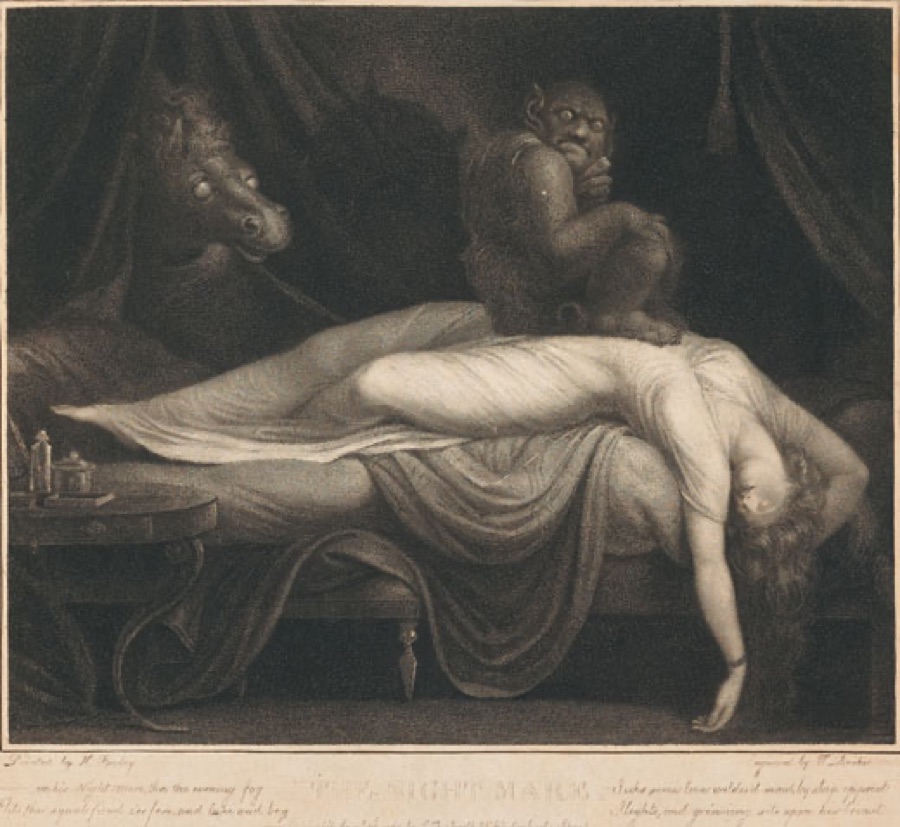
The word carries its own history. The mare in nightmare is not a horse. It comes from an Old English and wider Germanic term for a malevolent presence that sits on the chest of a sleeper. The dream was named after the pressure rather than after the fear.
That is not an arbitrary image. Sleep paralysis produces exactly that experience, immobility with a sense of a presence and weight on the chest, and it occurs in every population that has been asked about it. The folklore follows the physiology with striking consistency: the Old Hag in Newfoundland, kanashibari in Japan, and pressing or riding spirits across a long list of other traditions. The same neurological event, described independently in many places, produced remarkably similar stories.
The moral reading is a separate and later layer. Medieval European accounts of the incubus and succubus attached fault to the experience, so that a person waking terrified also had to account for why they had been visited. That is worth registering, because the reflex to treat a bad dream as evidence about the dreamer's character is old and is still running.
Not every tradition treats them as attacks. A range of practices, including several indigenous North American ones, treat frightening dreams as material to be brought to other people and worked with rather than as a private affliction, which is closer to the modern clinical approach than the medieval European reading is.
Where it came from
The medical history begins with the nightmare as a physical complaint. Early modern writers treated it as a digestive or circulatory problem brought on by sleeping on the back or eating badly before bed, and that remained the mainstream view for centuries.
Henry Fuseli's painting The Nightmare, exhibited in 1781, fixed the older image in popular memory at exactly the moment medicine was moving away from it: a sleeping woman, a squatting creature on her chest, a horse's head in the dark behind. It is still the most widely reproduced picture of a state most people now understand as sleep paralysis.
Ernest Jones, Freud's colleague and biographer, published On the Nightmare in 1931, reading the whole tradition of incubus and witch through psychoanalysis. It is a serious book, its explanatory framework has not survived, and its historical material is still useful.
The measurable phase begins with the discovery of REM sleep in 1953 and the laboratory work that followed, which established when in the night nightmares occur and separated them from night terrors for the first time on physiological grounds rather than by description.
Treatment is the most recent development of all. Imagery rehearsal therapy was developed and trialled through the 1990s and 2000s, principally by Barry Krakow and colleagues, and it changed the standing of the subject: chronic nightmares stopped being only a symptom to be explained and became a complaint that could be addressed in its own right.
The common misreading
The commonest misreading is treating a nightmare as a warning about something that is going to happen. Nothing in the research supports it, and the mechanism runs the other way. Nightmare content tracks what is already worrying a person, which is precisely why a nightmare can feel prophetic afterwards. A dream about a disaster is evidence that the disaster is on your mind.
The second is reading a nightmare as a verdict on the dreamer. The imagery of frightening dreams is often violent, humiliating or shameful, and people conclude something about themselves from having produced it. Content research is clear that aggression and misfortune are ordinary features of ordinary dreams right across the population. Having had a violent dream places nobody in a special category.
The third is the opposite error, and it is the one that keeps people from getting help: dismissing frequent nightmares as just dreams. They respond to treatment, and leaving them alone has real costs to sleep and to daytime life. Where the same nightmare returns, recurring dreams covers what is known about repetition specifically.
The fourth is looking the image up. A nightmare about a stranger following you or about being chased is not decoded by finding out what strangers or pursuit are supposed to signify, and why dream dictionaries do not work applies here with more force than anywhere else on this site, because a frightening dream is exactly the moment a person is most willing to accept a confident answer from anybody offering one.
Questions to sit with
- How often is this happening, and how long has it been going on?
- Did the nightmares start around a particular time, and what else changed then?
- Is it affecting your sleep or your day, as opposed to being unpleasant at the time?
- Who could you tell about this, and what has stopped you so far?
Look up what you actually dreamed.